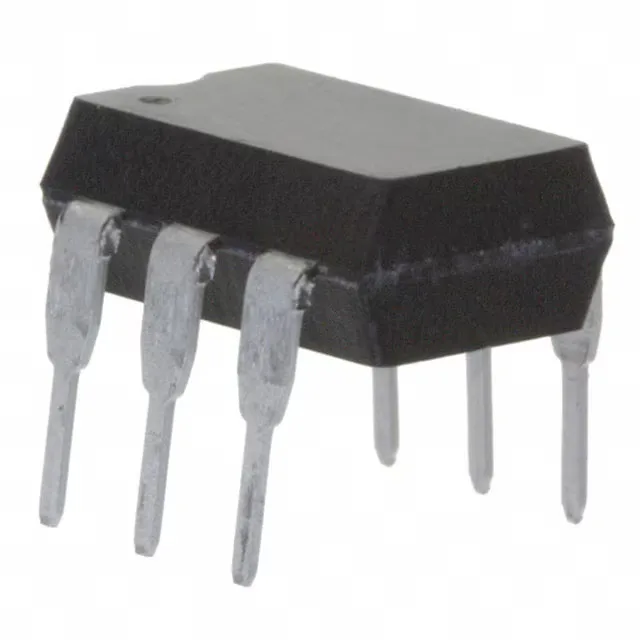
The MOC8103 is a single-channel phototransistor optocoupler in a through-hole 6-DIP package, rated for 5300Vrms galvanic isolation. That isolation voltage is the headline spec: it qualifies the part for safety-barrier applications in industrial controls, motor drives, and power supplies where you need to separate a low-voltage control side from a high-voltage power stage. The input side is a DC-driven IR LED (1.25V forward voltage typical), the output is a phototransistor that can sink up to 50mA per channel with a maximum collector-emitter voltage of 30V.
CTR 108%–173% — the transfer ratio that drives the design
The current transfer ratio (CTR) is the key parametric for any optocoupler: it tells you how much output collector current you get for a given LED forward current. For the MOC8103, CTR is specified at 108% minimum and 173% maximum, both measured at 10mA LED current. That means at 10mA in, you get at least 10.8mA and at most 17.3mA of output drive — a fairly tight bin that simplifies worst-case design. The 400mV Vce saturation at that drive level means the output transistor pulls close to ground when fully on, which is clean for logic-level interfacing.
Switching speed and temperature range
Turn-on time is 3µs typical, turn-off 2.3µs typical, with rise and fall both at 2µs. That puts this part in the medium-speed class — fine for 50/60Hz line sync, relay drivers, and status feedback, but not for high-speed data or switching supplies. The 60mA absolute-maximum LED forward current gives headroom for pulsed operation, but continuous drive should stay well below that.
It is ROHS3 compliant.