5300 Vrms isolation across four channels — what it buys you
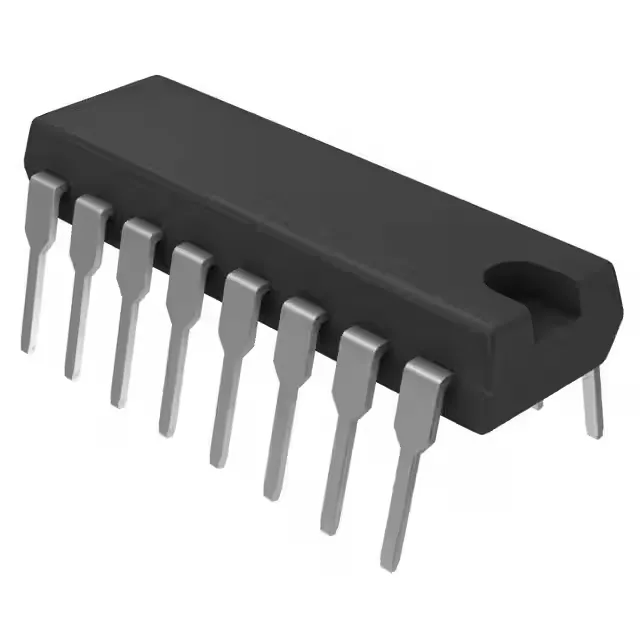
The Vishay ILQ1 is a 4-channel phototransistor optocoupler in a 16-pin DIP through-hole package. The 4-channel density in a single DIP saves board area versus four single-channel parts and simplifies the pick-and-place bill of materials to one line item.
CTR and switching speed — the real design margins
The current transfer ratio spans 20% to 300% at 10 mA forward current — a wide window that guarantees the output transistor saturates even when the LED is driven at the low end of its range or has aged. At the typical forward voltage of 1.25 V, a 10 mA drive stays well under the 60 mA absolute maximum, so the LED junction temperature stays controlled. Turn-on time is 700 ns typical, turn-off 1.4 µs typical, with rise and fall times of 1.9 µs and 1.4 µs respectively. That is fast enough for 100 kbps digital isolation in most fieldbus and I/O applications, but not for high-speed serial links — for those you would look at a digital isolator or a faster optocoupler family.
Output ratings: 50 V, 50 mA per channel
Each of the four transistor outputs can sink up to 50 mA at a maximum collector-emitter voltage of 50 V, with a saturation voltage of 400 mV at rated current. The 400 mV Vce(sat) means the output drops comfortably below the TTL low threshold even with some load, so no extra buffer stage is needed for most logic interfaces.
Active, ROHS3, and through-hole — a stable BOM line
The 16-DIP through-hole package is a mature, widely socketed footprint that is straightforward to hand-assemble or wave-solder — no reflow profile to qualify.