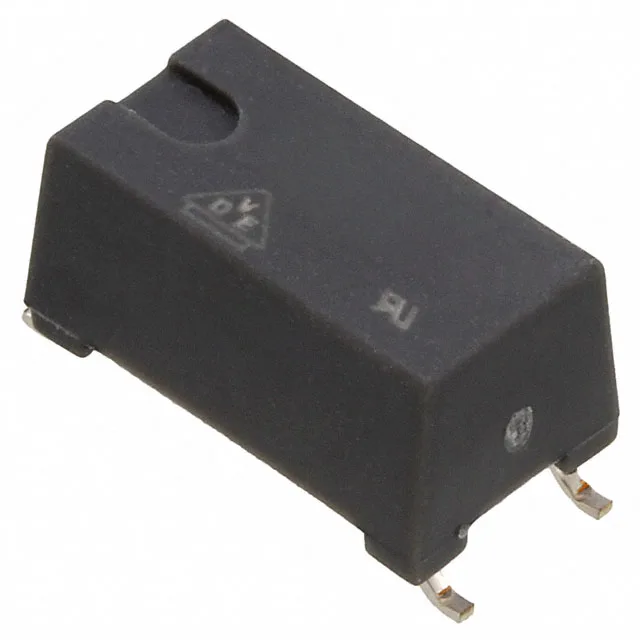
8200Vrms isolation in a through-hole DIP
The Vishay CNY64B is a single-channel optocoupler with a transistor output, packaged in a 4-DIP through-hole housing. Its headline rating is 8200Vrms isolation voltage — enough for reinforced isolation in industrial drives, medical patient-contact interfaces, and power-supply feedback loops where galvanic separation between primary and secondary is mandatory. The through-hole DIP footprint (0.200" pin spacing) suits designs where creepage distance matters more than board density, or where hand-assembly and rework are the norm.
Current transfer ratio is specified between 100% and 200% at a forward current of 10mA. That is a tight, well-bounded window — the designer can size the pull-up resistor and input threshold knowing the transistor will not saturate too hard or deliver too little drive across temperature. Typical turn-on time is 5µs and turn-off 3µs, with rise/fall of 2.4µs and 2.7µs respectively. That puts the CNY64B in the general-purpose phototransistor class — fine for 10-50 kbaud serial isolation, relay drivers, and status feedback, but not for high-speed digital buses.
Military temperature range — not just a marketing bullet
The 4-DIP package also handles the thermal cycling better than a small SOT-23 or SOIC — the leadframe and mould compound are built for that kind of duty.
Output ratings — 32V, 50mA, 300mV saturation
The transistor side is rated for 32V maximum output voltage and 50mA continuous output current. That means a 5V system can drive it through a series resistor in the 330-470Ω range comfortably, and a 3.3V system works with a lower resistor value as long as the 75mA absolute maximum is respected.
For a through-hole optocoupler with a 30+ year production history, that is a solid supply signal — the part is not being quietly sunset. The ROHS3 compliance (exemptions for lead in solder joints, if any, are per the standard) means it ships into EU and California markets without restriction.