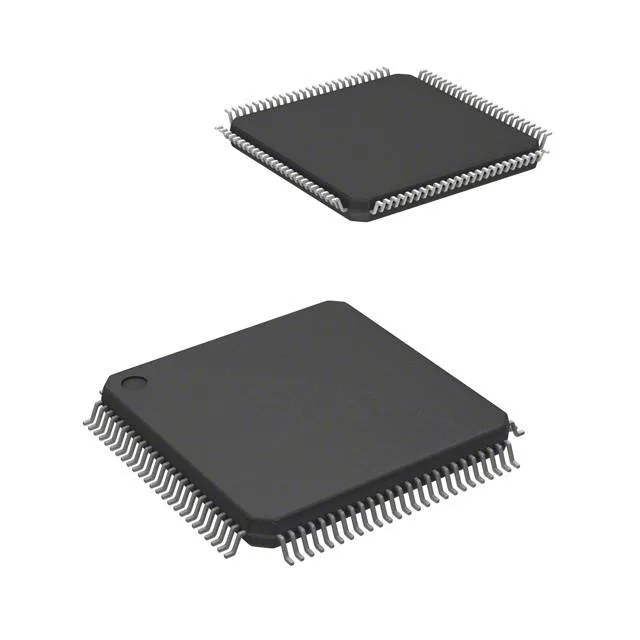
72 MHz Cortex-M3 with 1 MB Flash — the memory and speed envelope
The STM32F103VGT7: This memory footprint supports a full RTOS, a TCP/IP stack, and a moderate application layer without external memory — the 1 MB program space holds roughly 500 KB of compiled firmware after the HAL and middleware overhead, leaving headroom for field-upgradeable code. The 72 MHz core delivers about 90 DMIPS from the Cortex-M3 pipeline — enough for real-time control loops, sensor fusion, or protocol bridging. The flash wait-state controller at this clock speed inserts 2 wait cycles for zero-wait access; the prefetch buffer mitigates the penalty for sequential code.
Peripheral set and connectivity — CAN, USB, motor control PWM
On-chip peripherals include DMA, multiple motor-control PWMs with complementary outputs and dead-time insertion, a temperature sensor, and windowed watchdog timers. The PWM timers can drive a 3-phase inverter directly — the dead-time registers and brake input make this part suitable for brushless DC or permanent-magnet synchronous motor drives without an external FPGA. Connectivity covers CANbus (2.0B active), USB 2.0 full-speed device, I²C, SPI, UART/USART with IrDA and LIN support, and a multi-master I²C interface. The CAN controller handles the 11-bit and 29-bit identifier frames; the USB peripheral runs without an external crystal if the internal oscillator is trimmed. The 80 general-purpose I/O pins are 5 V-tolerant on most ports, simplifying level translation when interfacing with legacy 5 V logic or industrial sensors. The I/O mapping leaves enough headroom for a 16-bit parallel LCD interface plus a full set of serial peripherals.
Industrial temperature grade and package — board-fit constraints
The internal POR and PVD circuits monitor the supply; the PVD threshold is programmable to trigger an interrupt before the brown-out reset level.
RoHS3 compliant (2011/65/EU + 2015/863) with no exemptions.