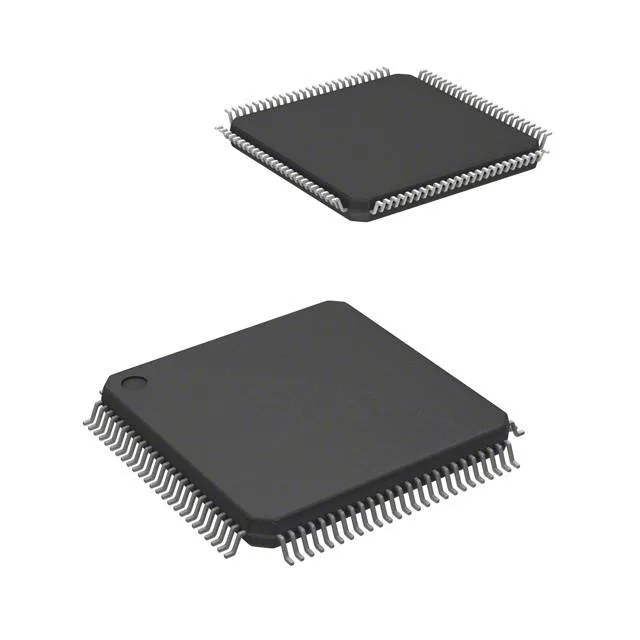
STMicroelectronics STM32F103VET6TR — Microcontrollers & Processors (MCU / MPU / DSP)

STM32F103VET6TR STM32F1 MCU 72MHz 512KB Flash 100-LQFP

MPNSTM32F103VET6TR
Active

STMicroelectronics STM32F1 series, ARM Cortex-M3 32-bit MCU, STM32F103VET6TR, 72MHz, 512KB Flash, 64K x 8 RAM, 100-LQFP (14x14 mm), -40 to 85°C.

$10.8300Ref. price · indicative, final on quote
Packaging100-LQFP
RoHSROHS3 Compliant
SeriesSTM32F1
Independent supplier — new & surplus stockAuthenticity-screened · ESD-safe packingListing updated Aug 2026

Specifications

STM32F103VET6TR specifications
ParameterValue
SeriesSTM32F1
MountingSurface Mount
Oscillator typeInternal
Program memory typeFLASH
Voltage - supply (Vcc (Vdd))2V ~ 3.6V
Operating temperature-40°C ~ 85°C (TA)
Speed72MHz
PackageTape & Reel (TR) Cut Tape (CT)
RAM size64K x 8
Core size32-Bit Single-Core
PeripheralsDMA, Motor Control PWM, PDR, POR, PVD, PWM, Temp Sensor, WDT
ConnectivityCANbus, I²C, IrDA, LINbus, SPI, UART/USART, USB
Number of i (O)80
Core processorARM® Cortex®-M3
Case100-LQFP
Data convertersA/D 16x12b; D/A 2x12b
Program memory size512KB (512K x 8)

Product details

Core, memory, and package — the BOM-fit triangle

The STM32F103VET6TR is an ARM Cortex-M3 core running at 72 MHz, with 512 KB of on-chip Flash program memory and 64 KB of SRAM — enough headroom for a real-time control loop with moderate data logging, a communication stack, and a small RTOS footprint without external memory. Housed in a 100-LQFP package (14x14 mm body), the 0.5 mm pitch demands a 4-layer PCB for reliable fan-out of the 80 I/O lines, especially when routing the CAN, SPI, and multiple USART channels the part brings to the board.

Peripherals that decide the system architecture

Motor control PWM, a temperature sensor, and DMA controllers are built in, so a single-chip servo drive or BLDC controller can close the current loop without a dedicated DSP companion. Connectivity covers CANbus (for automotive or industrial fieldbus backbones), I²C (for sensor hubs and EEPROMs), SPI (for external ADCs or display drivers), and multiple USARTs with IrDA and LIN support — the part can serve as the central node in a multi-protocol gateway.

Sourcing posture and lifecycle visibility

Cut Tape (CT) options are also listed for prototype or low-volume builds. RoHS3 compliant per the manufacturer's declaration — no exemption expiry concerns for EU-market equipment shipping through 2025 and beyond.

What the 72 MHz ceiling means for the real-time loop

At 72 MHz, the Cortex-M3 executes one instruction per clock cycle for most Thumb-2 instructions, giving roughly 1.25 DMIPS/MHz — about 90 DMIPS total. A control loop with 200 instructions of overhead and a 10 kHz update rate consumes roughly 2 MHz of that budget, leaving the rest for communication stacks and background tasks. Flash wait states kick in above 24 MHz at 3.3 V — the prefetch buffer and ART accelerator hide most of the penalty for sequential code, but a tight loop that jumps across flash pages sees 2-3 cycle stalls. Placing time-critical ISRs in SRAM avoids this entirely.

Frequently asked questions

How does STM32F103VET6TR compare to STM32L151CBU6A for a drop-in replacement?

The STM32L151CBU6A is a lower-power Cortex-M3 variant running at 32 MHz with 1.8 V supply, in a smaller 48-pin package. It is not pin-compatible with the 100-LQFP STM32F103VET6TR and lacks the 72 MHz throughput, CANbus, and 80 I/O — a board redesign is required, not a simple swap.

What compliance documentation does STMicroelectronics provide for STM32F103VET6TR?

The part is RoHS3 compliant. STMicroelectronics provides a full datasheet, reference manual, and PCN notifications through their standard document portal. No UL or IEC certification is listed for this MCU.

Where can I source STM32F103VET6TR for a volume BOM?

This part is sourced to order against your BOM quantity through independent distribution.