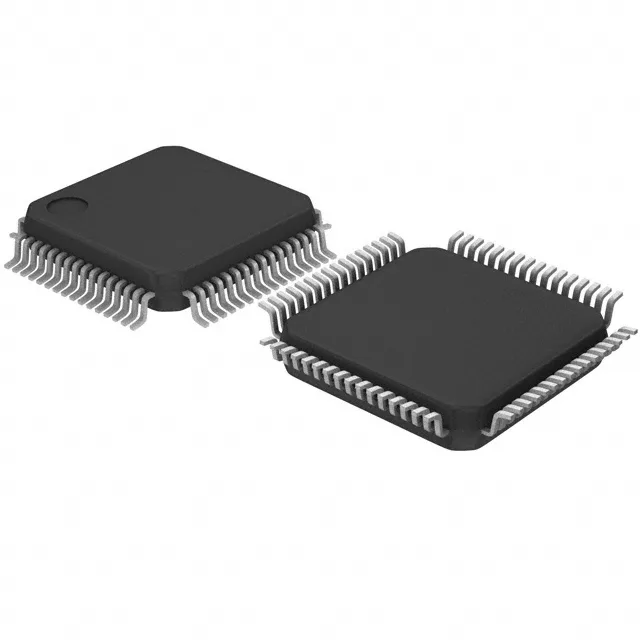
24 MHz Cortex-M3 with 256 KB Flash — memory and speed budget
The STM32F100RCT6BTR: The 24 MHz ARM Cortex-M3 core delivers enough throughput for moderate-complexity control loops, sensor fusion, and protocol bridging without the power draw of a higher-clocked part. The 256 KB on-chip Flash and 24 KB SRAM leave headroom for a real-time operating system, a communication stack, and a moderate application layer — a firmware engineer budgeting for a FreeRTOS-based design with a CANopen or Modbus stack will find the Flash adequate for most field-device firmware images. The 16-channel 12-bit ADC and dual 12-bit DAC allow direct sensor interfacing and analog output without external converters — useful for a motor-drive current-sense or a temperature-monitoring front-end. The peripheral set includes DMA, PWM, a temperature sensor, and a watchdog timer, reducing the need for external glue logic and keeping the BOM count low.
64-LQFP package and 51 I/O — board-fit and routing
Housed in a 64-LQFP with a 10x10 mm body, this MCU fits a standard fine-pitch QFP footprint that routes well on a two-layer board for moderate I/O counts. The 51 general-purpose I/O lines support parallel interfaces, keypad matrices, and multiple serial buses simultaneously — a systems architect can allocate dedicated lines for an external SRAM or a parallel LCD without multiplexing.
Connectivity and peripheral integration
Serial interfaces include I²C, SPI, UART/USART, LIN, and IrDA — enough to connect to common sensor modules, display drivers, and fieldbus transceivers without an external UART or I²C bridge. The internal oscillator saves an external crystal for applications that tolerate the internal RC accuracy; a firmware engineer can use the HSI oscillator for boot and switch to an external crystal when tighter timing is needed.
Sourcing and compliance
The part is ROHS3 compliant, meeting the current EU RoHS exemption limits. No second-source or pin-compatible replacement is documented by the manufacturer — the STM32L151CBU6A is a functionally similar Cortex-M3 part with 32 MHz and lower power, but it uses a different package and pinout, so a board spin would be required for a drop-in swap.