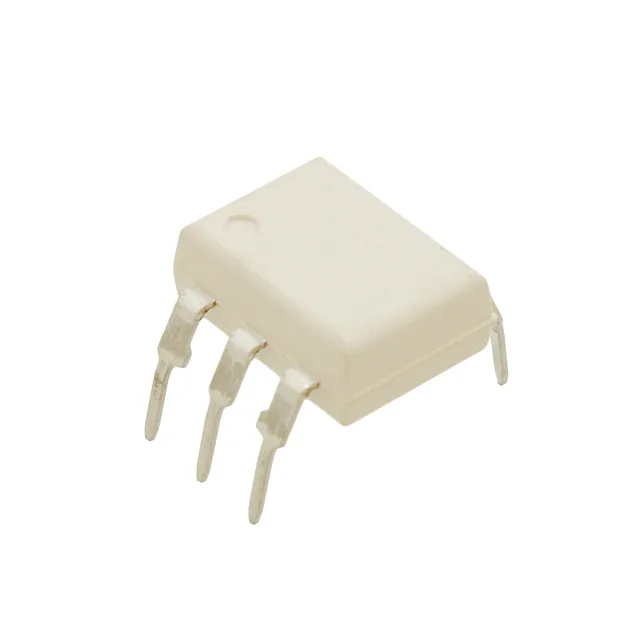
Triac output with zero-crossing for clean AC switching
The onsemi MOC3061TVM is a 1-channel optoisolator with a triac output and integrated zero-crossing circuit, packaged in a 6-DIP through-hole package (0.400", 10.16mm pitch). The zero-crossing detector fires the triac only when the AC line voltage nears zero, which limits the inrush current into capacitive or resistive loads and reduces conducted EMI at turn-on — a practical advantage for switching heaters, lamps, or solenoid valves from a microcontroller output. Rated for off-state voltages up to 600 V and with a minimum static dV/dt of 600V/µs, this part tolerates the fast-rising transients common on inductive AC lines without false triggering.
Sourcing and compliance snapshot
It carries IEC/EN/DIN and UL approval for 4170Vrms isolation — the safety barrier between the low-voltage control side and the mains-connected triac output.
Drive requirements and output latching
The input LED forward voltage is 1.3 V typical; the detector requires a maximum LED trigger current (Ift) of 15 mA to switch the triac on, and the LED can be driven continuously up to 60 mA DC forward current. Once triggered, the triac output latches on until the load current drops below the typical 500 µA hold current (Ih) — this means the part naturally commutates off near the AC zero-crossing point, matching the behavior of the zero-crossing turn-on.