Galvanic isolation for industrial logic interfaces
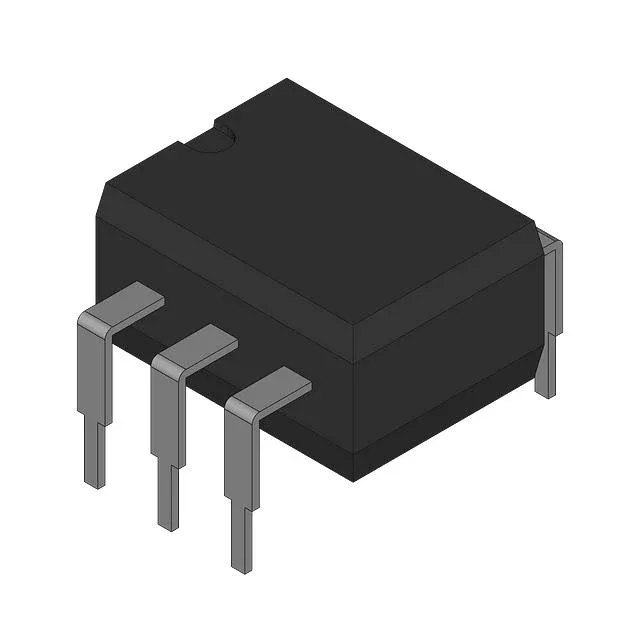
The onsemi H11AV1VM is a single-channel transistor-output optocoupler in a 6-DIP through-hole package, designed to pass a DC logic signal across a 4170Vrms isolation barrier. That isolation rating covers reinforced insulation per IEC 60950-1 for mains-touched circuits — think PLC digital inputs, motor-drive fault feedback, or any signal crossing from the high-voltage domain to the low-voltage control side.
CTR spread and switching speed — what they mean for the BOM
That 3:1 min-to-max spread means the downstream pull-up resistor and logic threshold must be sized for the weakest unit at end-of-life and worst-case temperature. A design targeting 5V logic with a 10kΩ pull-up and 100μA collector current at the minimum CTR will still have margin when the CTR drifts downward over 100k hours. Turn-on and turn-off times are both 15µs typical (15µs max). This limits the useful switching frequency to roughly 33 kHz before the output waveform distorts — fine for 50/60 Hz line sync, relay coil drivers, or slow sensor readback, but not for high-speed serial isolation or PWM above a few kilohertz. The output transistor is rated for 70V collector-emitter maximum with a saturation voltage of 400mV at the rated forward current. That 70V ceiling comfortably handles 24V industrial rails and 48V telecom buses with derating margin; the low Vce(sat) keeps power dissipation in the output stage under 100mW at moderate collector currents.
Temperature grade and deployment environment
The 6-DIP through-hole package with 7.62mm pin spacing is a standard footprint for wave-solder or socketed assembly — no special reflow profile needed.