Isolation rating and signal transfer
The H11AV1SR2VM: 4170Vrms isolation between input and output — this is the withstand voltage for a reinforced insulation barrier, sufficient for industrial control interfaces and medical-grade power supplies where the safety standard demands a 4 kV minimum. Current transfer ratio spans 100% to 300% at a forward current of 10 mA — the minimum CTR guarantees the output transistor saturates with the LED drive held to a known level, while the maximum prevents overdrive that could saturate the phototransistor too deeply and slow the turn-off. Typical turn-on and turn-off times are 15 µs each (15 µs max) — this sets the maximum data rate through the isolator at roughly 33 kHz for a 50% duty cycle, adequate for 50/60 Hz line synchronisation, relay driver signals, and slow PLC input debounce, but not for high-speed serial buses.
Output drive and thermal limits
Maximum collector-emitter voltage is 70 V, and the output transistor saturates at 400 mV maximum — the low Vce(sat) keeps power dissipation under 5 mW at a 10 mA collector current, so the part runs cool in a 100°C ambient without derating. Operating temperature range -40°C to 100°C covers industrial enclosures and outdoor telecom cabinets — the 100°C upper limit is the junction temperature of the phototransistor, not just ambient, so a high-side load that raises the package temperature above 85°C still has margin before the CTR degrades.
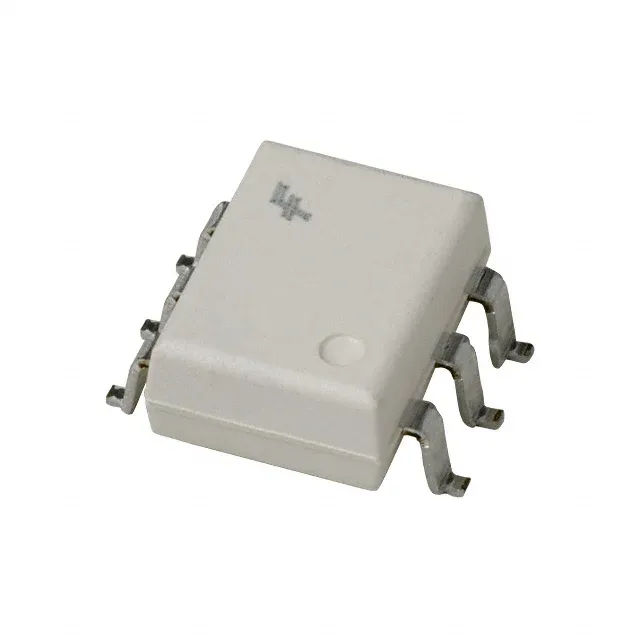
6-SMD Gull Wing package (supplier device package 6-SMD) — the gull-wing leads extend beyond the body for visual solder-joint inspection, and the 1.27 mm pitch matches standard SOIC-6 land patterns. The package body is compatible with reflow profiles up to 260°C peak per J-STD-020. CT is for prototype or low-volume builds.
No pin-compatible second source or cross-reference is recorded in the base product number H11AV family — the H11AV1SR2VM is a single-source item from onsemi.