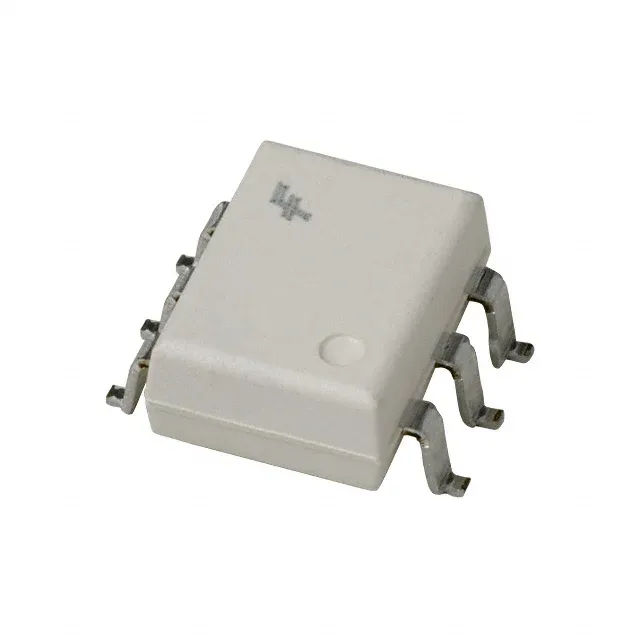
Active production — 4170 Vrms reinforced isolation in a 6-SMD gull wing
The onsemi H11AG1SM is an active-production, 1-channel optoisolator with a transistor-with-base output, rated for 4170 Vrms of isolation between input and output — a reinforced isolation level suitable for breaking ground loops and protecting low-voltage logic from high-side transients in industrial and power-supply feedback circuits. Packaged in a 6-SMD gull wing (6-SMD, Gull Wing) for surface-mount assembly, it accepts DC input and delivers up to 50 mA output current per channel, with a maximum output voltage of 30 V. Operating from -40°C to 100°C, the H11AG1SM covers the industrial temperature grade — the full range for factory-floor control modules, motor-drive feedback paths, and isolated sensor interfaces that see ambient heat in sealed enclosures.
Transfer ratio and switching — 100 % CTR at 1 mA, 5 µs edges
The minimum current transfer ratio of 100 % at a forward current of 1 mA means the output transistor can sink at least as much collector current as the LED drive current — a 1:1 or better gain that makes the part usable with low-power logic outputs without an external driver stage. Typical turn-on and turn-off times are both 5 µs, giving a symmetric switching response that simplifies timing budget calculations for isolated data lines running below 100 kHz.