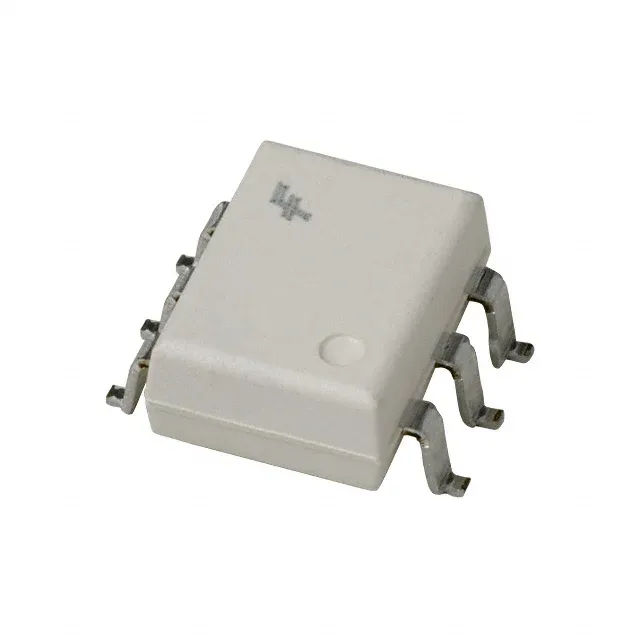
AC/DC input — one opto for line or DC bus sensing
The H11AA4SDM accepts both AC and DC input, so it can sense mains zero-crossing or DC bus voltage directly — no external bridge rectifier or polarity protection. That saves two diodes and a resistor on a line-monitor BOM. Isolation is 4170 Vrms, which exceeds the 3750 Vrms reinforced insulation requirement per IEC 60950-1. It qualifies for primary-to-secondary safety barriers in AC mains interface circuits like solid-state relay drivers and power supply feedback loops.
CTR floor and drive margin
Minimum current transfer ratio is 100% at 10 mA forward current. At the worst-case cold junction, the output transistor still pulls enough collector current to saturate a logic input or drive a low-power relay — no gain-margin guesswork. Maximum Vce saturation is 400 mV, so the output drops less than half a volt at rated load. Forward voltage is 1.17 V typical, and the DC forward current limit is 60 mA. The input LED can be driven from a 5 V rail through a single 390-ohm series resistor — no current regulator needed for the 10 mA test condition.
Package, footprint, and board integration
The 6-SMD Gull Wing package uses the standard SOIC-6 footprint — 0.100-inch pitch, 0.300-inch body width. It reflows on a standard lead-free profile with no exposed paddle; no thermal pad or via array is needed. Pick-and-place compatible with a 12 mm tape width; the gull-wing leads self-center during reflow. In an outdoor telecom cabinet that hits 85°C on a summer day, the opto still has 15°C of margin before the LED output degrades.
New designs can commit to this part without an LTB risk window. The base product number is H11AA, a long-running optoisolator family. Multiple onsemi package variants share the same die — the SDM suffix is the 6-SMD Gull Wing tape-and-reel option. Sourced to order against RFQ; availability confirmed at quote time.