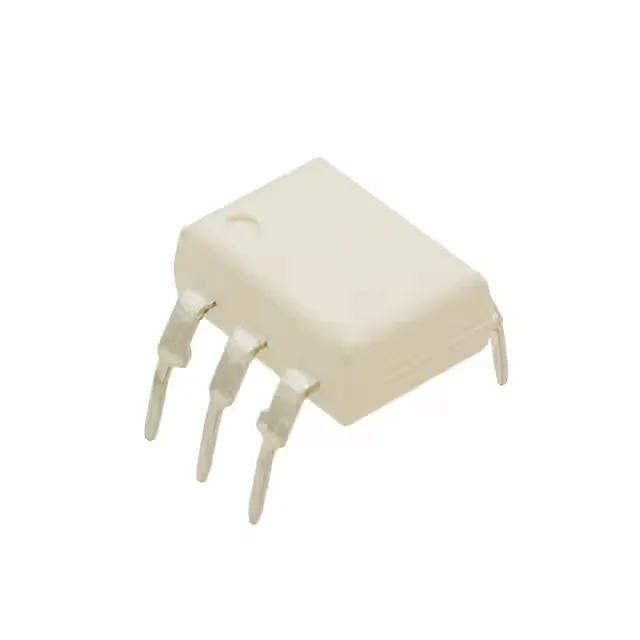
onsemi H11AA1M — Optoisolators

H11AA1M onsemi Optoisolator – 4170Vrms AC/DC Input, 6-DIP

MPNH11AA1M
Active

onsemi H11AA1M, 1-channel optoisolator, 6-DIP through-hole package, 4170Vrms isolation, AC/DC input, transistor output with base access, -40°C to 100°C operating range.

$0.9500Ref. price · indicative, final on quote
Packaging6-DIP (0.300", 7.62mm)
RoHSROHS3 Compliant
Independent supplier — new & surplus stockAuthenticity-screened · ESD-safe packingListing updated Aug 2026

Specifications

H11AA1M specifications
ParameterValue
Input typeAC, DC
Output typeTransistor with Base
MountingThrough Hole
Voltage - isolation4170Vrms
Voltage - output30V
Voltage - forward (Vf)1.17V
Current - output (Channel)50mA
Current transfer ratio20% @ 10mA
Current - DC forward (If)60 mA
Operating temperature-40°C~100°C
PackageTube
Case6-DIP (0.300\", 7.62mm)
Channels1
Vce saturation400mV

Product details

AC/DC input detection without an external bridge

The H11AA1M accepts both AC and DC input drive, which means a single optoisolator can sense 50/60 Hz mains voltage or a DC logic signal without adding a diode bridge on the primary side. The internal back-to-back LEDs handle the AC polarity reversal — the phototransistor turns on across both half-cycles, giving you a full-wave detection pulse that a microcontroller timer can measure for zero-crossing or frequency counting. Isolation is rated at 4170Vrms, a common figure for reinforced insulation in 240VAC line-monitoring circuits. The 6-DIP (0.300-inch, 7.62mm) through-hole package keeps creepage distance above 8 mm, which simplifies PCB layout for safety-agency clearance requirements.

Transistor output with base access for speed trade-offs

Unlike many optoisolators that only expose the collector and emitter, the H11AA1M brings out the phototransistor base. This lets you add a resistor between base and emitter to speed up turn-off at the cost of reduced current-transfer ratio — useful when the downstream logic expects a clean edge at line-frequency transitions. The minimum CTR is 20% at 10 mA forward current, so with a 10 mA AC input the output can sink 2 mA into a 5V pull-up while staying below the 400mV Vce(sat) ceiling. Maximum output voltage is 30V and continuous output current per channel is 50 mA. These ratings suit 5V or 12V logic rails, but the 30V ceiling also covers 24V PLC input modules — the phototransistor can drive a 24V pull-up through a current-limiting resistor without exceeding the breakdown.

Active production — no immediate EOL risk

The base product number H11AA covers multiple CTR and package variants, so if future design changes require a different CTR bin, the footprint and pinout stay the same. The through-hole 6-DIP is a mature, widely second-sourced package; no fine-pitch reflow concerns.

Frequently asked questions

Is H11AA1M obsolete?

No — the H11AA1M is listed as Active by onsemi. For BOM planning, the base number H11AA covers multiple CTR and package options, so a future switch to a sibling variant would keep the same PCB footprint.

Can H11AA1M be used for 120V AC sensing?

Yes. The AC input capability means the internal back-to-back LEDs conduct on both half-cycles of a 120VAC line. You need an external series resistor to limit the LED current to the 60 mA absolute maximum — a typical value is 22 kΩ for 120VAC, which yields about 10 mA peak forward current. The 4170Vrms isolation rating provides reinforced insulation for line-voltage circuits.

What is the closest pin-compatible alternative to H11AA1M?

Within the same H11AA family, the H11AA1 is the standard CTR variant. The H11AA1M uses the same 6-DIP footprint and pinout — the 'M' suffix typically indicates a specific CTR bin or packaging option. Vishay and Lite-On also offer AC-input optoisolators in the same 6-DIP outline, but pin compatibility should be verified against the respective datasheets because base-access vs. base-not-connected assignments differ between manufacturers.