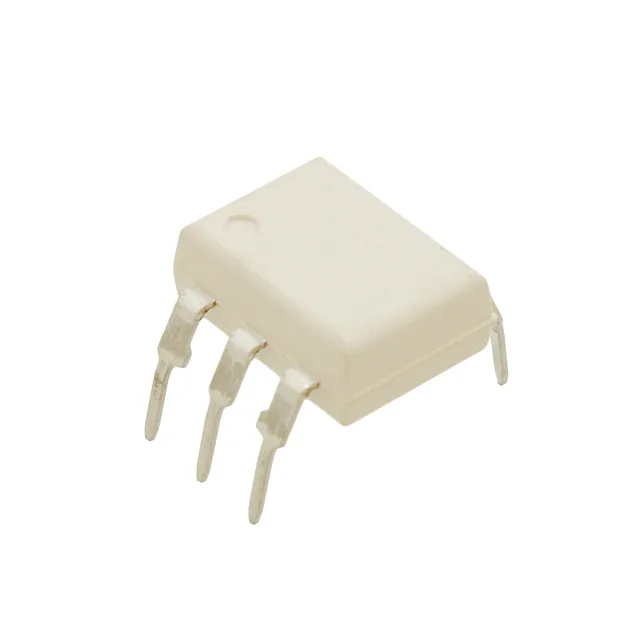
Single-channel phototransistor isolator with base access
The H11A1TVM is a single-channel optoisolator from onsemi that couples a DC-input LED to a phototransistor output with an exposed base terminal. The base pin gives the designer the option to add a speed-up resistor or a base-emitter shunt for improved noise immunity — a feature missing from simpler three-pin optocouplers. Rated for 4170Vrms isolation between input and output, it suits galvanic isolation in AC mains sensing, relay drivers, and PLC digital input modules where the safety barrier must withstand 250VAC or 400VDC working voltage with margin.
With a minimum current transfer ratio of 50% at 10mA forward current, the H11A1TVM guarantees that 10mA into the LED will pull the output transistor into saturation for a collector load up to 5mA. If the output load draws 10mA, the LED must be driven with at least 20mA — well within the 60mA absolute-maximum forward current rating. Typical turn-on and turn-off times are both 2µs, which is adequate for 50/60Hz line-frequency switching, zero-cross detection, and slow digital signals up to a few kilohertz. For applications needing faster data rates — above 10kHz — a logic-output optocoupler with a photodiode detector would be a better fit.
Package and temperature grade — through-hole legacy, industrial range
The H11A1TVM is supplied in a through-hole 6-DIP package with a 0.400-inch (10.16mm) body width. The 100°C upper limit is the junction temperature — derate the LED forward current above 70°C ambient to stay within the safe operating area. onsemi lists the H11A1TVM as Active in production. It is ROHS3 compliant. No end-of-life notice or successor part has been published.