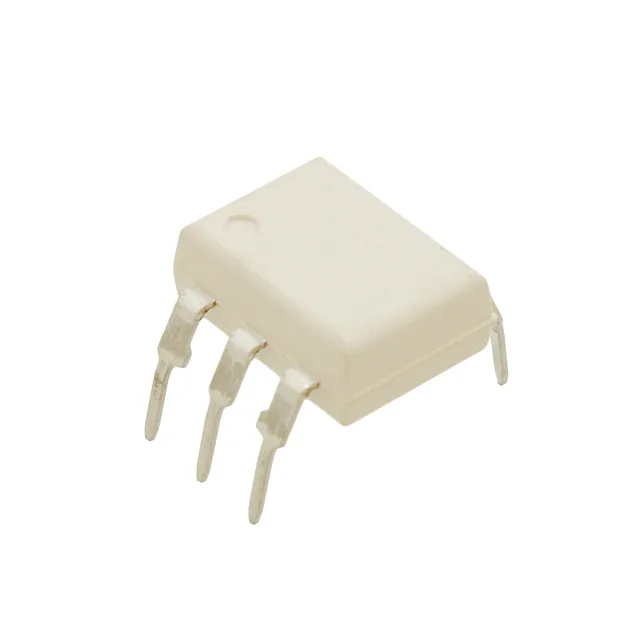
5300 Vrms isolation in a 6-DIP through-hole package
The H11A1300W: The 5300 Vrms isolation rating means this part provides reinforced galvanic isolation between the input LED and the output transistor — suitable for separating high-voltage power circuits from low-voltage control logic in motor drives, PLC I/O modules, and industrial sensor interfaces.
Current transfer ratio and switching speed — what they mean for the BOM
The minimum current transfer ratio (CTR) is 50% at a forward current of 10 mA. This means that with 10 mA through the LED, the output transistor can sink at least 5 mA — enough to drive a TTL logic input or a PLC digital input module directly, but marginal for driving a relay coil without a buffer transistor. Designers should verify the load current requirement against the CTR minimum, not the typical value, to guarantee operation across temperature and device variation. Typical turn-on and turn-off times are 2 µs each, giving a combined propagation delay of roughly 4 µs. This limits the usable switching frequency to about 125 kHz for a 50% duty cycle signal — adequate for 50/60 Hz power line zero-crossing detection, DC bus voltage sensing, and low-speed serial isolation, but too slow for high-speed communication links like CAN or RS-485 where sub-microsecond delays are required.
Temperature range and output ratings
Operating temperature spans -55°C to 100°C, covering the industrial temperature grade. This allows deployment in outdoor telecom cabinets, factory floor enclosures, and engine-bay-adjacent electronics where ambient heat is a factor. The output transistor is rated for a maximum collector-emitter voltage of 30 V and a saturation voltage of 400 mV maximum — the 30 V ceiling suits 24 V industrial logic rails, while the low saturation voltage minimizes power dissipation in the output stage. The LED forward voltage is 1.18 V typical, and the maximum continuous forward current is 100 mA. A current-limiting resistor in series with the LED is required; at 5 V logic drive, a 390 Ω resistor sets the forward current to about 10 mA — the same condition at which the CTR minimum is specified.
For buyers maintaining existing BOMs that specify this exact order code, the part can be sourced to order against the required quantity.