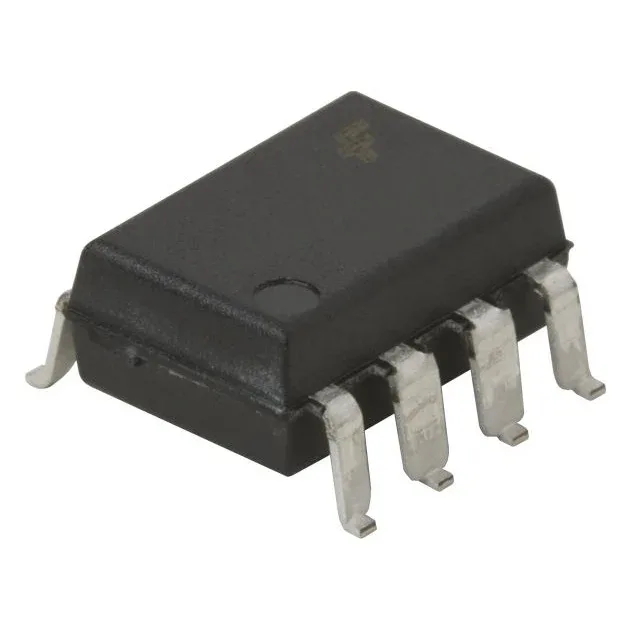
5 kV isolation in an 8-SMD Gull Wing — what that means for the BOM
The FOD2741ASDV is a single-channel transistor-output optocoupler from onsemi, rated for 5000 Vrms isolation between input and output. That 5 kV figure is the one-time withstand voltage per the test standard — it defines the safety barrier for applications where the primary and secondary sides must not share a ground fault path, such as in motor-drive feedback, PLC digital inputs, or isolated power-supply error amplifiers. The 8-SMD Gull Wing package (supplier device package 8-SMD) is a standard surface-mount footprint for automated assembly. The Gull Wing leads give good coplanarity and self-centering during reflow, but check the MSL before you place it — the moisture sensitivity level determines whether the parts need a bake before the oven to avoid popcorning.
CTR window and output drive — the real selection parameters
This 2:1 CTR window means the LED drive current can be set at 10 mA and the output transistor will always sink at least 10 mA and at most 20 mA at the same collector-emitter voltage — a tight enough spread to design a reliable logic-level interface without overdriving the LED or starving the output. The CTR also degrades with temperature and over the life of the LED; the 100% floor gives headroom for that aging. Output side: the transistor can handle up to 30 V across the collector-emitter junction and sink 50 mA continuous per channel.
It is ROHS3 compliant, so it clears the EU material restrictions without exemptions. This means the part is specified for factory-floor enclosures, outdoor telecom cabinets, and HVAC equipment — anywhere the ambient inside the box stays below 85°C.