What the 4170Vrms isolation buys you
The CNY172TVM is a single-channel optocoupler that provides 4170Vrms of galvanic isolation between a DC input LED and a phototransistor output with the base brought out. That isolation rating is the spec that decides whether this part can sit on a safety barrier between a low-voltage control side and a higher-voltage field side — think PLC digital inputs, motor drive feedback, or industrial sensor interfaces where the controller ground and the field ground must not share a path.
At a forward current of 10mA, the current transfer ratio is guaranteed between 63% and 125%. That spread means the output transistor can sink at least 6.3mA when the LED is driven at 10mA — enough to pull a standard TTL or CMOS input low through a pull-up resistor. The 70V collector-emitter rating and 50mA continuous output current give headroom for driving a relay coil or a small logic load directly, though the 400mV Vce(sat) at max output should be factored into the logic-low threshold budget.
Switching speed for non-isolated signal paths
Turn-on time is 2µs typical, turn-off 3µs typical, with rise and fall times of 4µs and 3.5µs max. That puts the usable switching frequency around 100 kHz for pulse edges, but the propagation delay asymmetry means this part is better suited for DC-level sensing or low-speed serial isolation than for high-speed data links. The base pin on the output side lets you add a speed-up resistor between base and emitter to reduce turn-off time — a common trick in industrial designs that need faster recovery.
Package and temperature range for the build
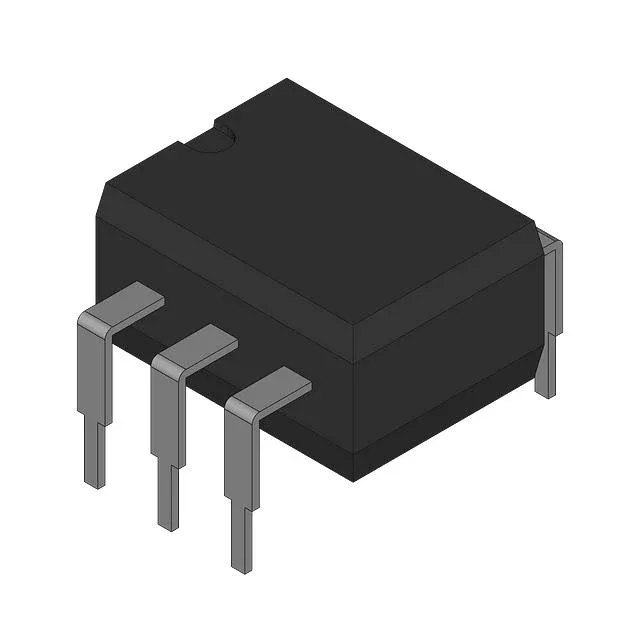
Housed in a 6-DIP with 0.400-inch (10.16mm) body width, the CNY172TVM is a through-hole part that hand-solders easily on a perfboard or a two-layer PCB.
onsemi lists the CNY172TVM as Active.