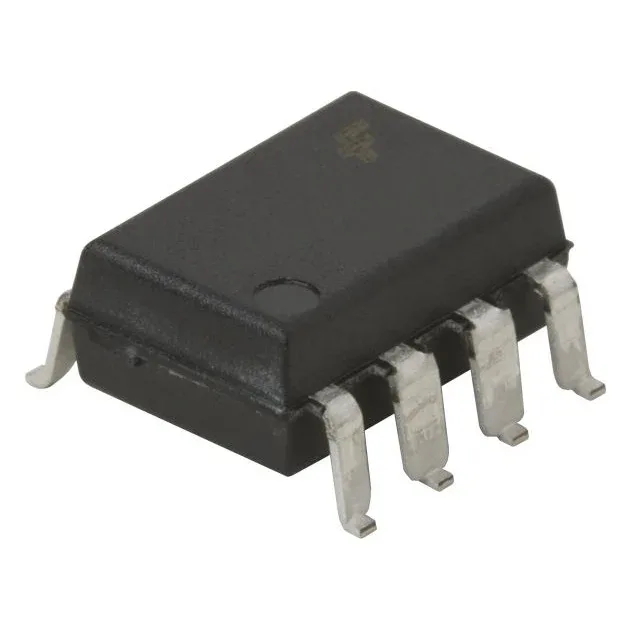
Isolation barrier and switching speed for industrial signal paths
The 6N136SDM is a single-channel optoisolator from onsemi, built with a DC-input LED and a phototransistor with base access on the output side. Its 5000Vrms isolation rating suits galvanic separation in motor-drive feedback, PLC digital inputs, and switch-mode power-supply error amplifiers where the primary and secondary sides must not share a ground path. Switching is specified at 250 ns turn-on and 260 ns turn-off typical — fast enough for 1 MHz data rates in isolated gate-drive or fault-signal paths, but not for high-speed serial buses like SPI or I²C without a Schmitt-trigger buffer on the output.
Current transfer ratio and 5V logic drive
The CTR floor is 19% at a forward current of 16 mA, with a maximum of 50%. At 19% CTR and an 8 mA output current capability, the output can pull a 5V logic input low through a 620 Ω pull-up resistor — marginal but workable if the downstream load capacitance stays under 50 pF. For 3.3V logic, the CTR margin is tighter; a buffer or a higher-CTR opto (e.g., 6N137 family) is a safer call. The base terminal on the phototransistor lets you add a base-emitter resistor to improve noise immunity or tailor the switching threshold — a feature missing from simpler phototransistor optos. That extra pin is worth a layout trace if the application runs in a noisy industrial environment.
Temperature range and package for surface-mount assembly
If your BOM calls the 6N136 DIP-8, the 6N136SDM is the SMD drop-in — same die, same ratings, different lead form.
The 8-SMD gull-wing package is widely second-sourced across the optoisolator industry — if onsemi supply tightens, a pin-compatible cross from Vishay or Toshiba (same package, same CTR band) can be qualified without a board spin.