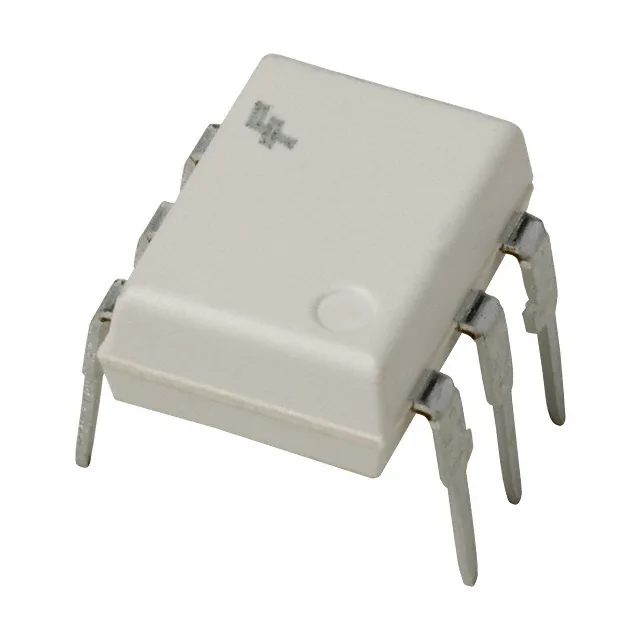
What this optoisolator does in your isolated interface
The 4N26M is a single-channel phototransistor optocoupler from onsemi that provides 4170Vrms galvanic isolation between a DC input LED and a transistor output with a base terminal. The base pin gives you the option to bias the phototransistor for faster switching or to connect a base-emitter resistor for noise immunity — a feature missing from simpler three-pin optos. The typical forward voltage is 1.18V at that current, so a 5V logic output driving the LED through a 390 Ω resistor lands right in the sweet spot. Switching is rated at 2 µs typical for both turn-on and turn-off, which limits the useful data rate to about 250 kbps in a simple digital isolator application. For higher-speed isolation, look at a logic-output optocoupler or a capacitive/inductive digital isolator.
Industrial temperature range and package fit
The 6-DIP through-hole package (0.300-inch body width) is a standard footprint shared by the entire 4Nxx family, so a board laid out for a 4N25 or 4N35 accepts the 4N26M without a layout change. Maximum collector-emitter voltage is 30V, and the output saturation voltage is 500 mV max at the rated collector current — typical for a phototransistor. The 60 mA absolute maximum LED forward current gives headroom for pulsed operation, but continuous drive should stay well below that to avoid degrading the LED over life.
The ROHS3 compliance means it meets current EU material restrictions without an exemption.