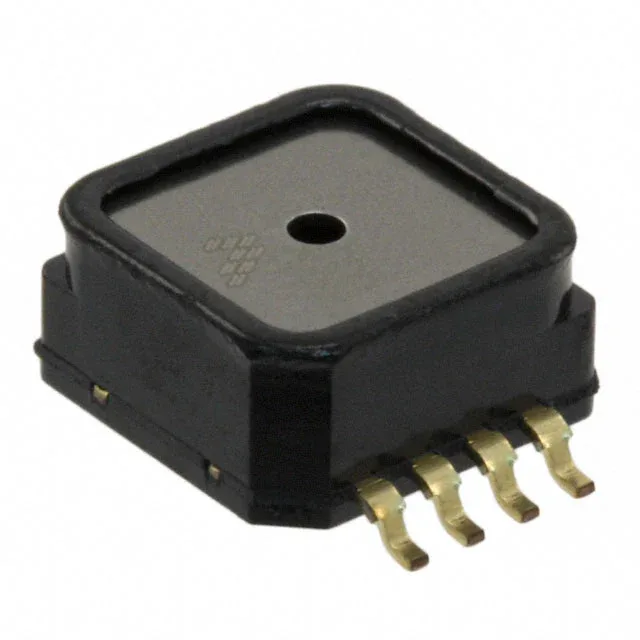
Pressure range and output — what the voltage tells you
The MPXHZ6250A6U is an absolute pressure sensor covering 20 kPa to 250 kPa, with a ratiometric analog output that swings from 0.3 V at the low end to 4.9 V at full scale (cites:,). That means a 5 V ADC reading 2.6 V knows the pressure is roughly 135 kPa — no scaling math beyond a straight-line transfer function. The ±1.5% accuracy over the full span means you can skip external trimming for most manifold absolute pressure (MAP) or barometric sensing jobs — the error budget fits inside a typical ECU's tolerance without a calibration step (cites:).
The on-chip temperature compensation keeps the output stable across that range without an external thermistor or lookup table in firmware (cites:). Supply it from a 5 V ±5% rail — common in automotive ECUs — and the output stays ratiometric with the supply, so a noisy 5 V bus directly shifts the reading (cites:). Keep the supply clean if you need the full ±1.5% spec.
Package, mounting, and the no-port reality
It comes in an 8-SOIC wide-body package (7.50 mm width) with gull-wing leads — standard footprint that reflows on a normal paste profile and is reworkable with hot air if you need to swap it in the field (cites:,). The supplier device package is 8-SSOP, same mechanical outline (cites:). No port means the pressure hits the top of the SOIC package directly — your PCB needs a sealed manifold or an O-ring interface over the sensor die, not a barbed hose fitting (cites:). Plan the mechanical interface before layout. Burst pressure is 1000 kPa, so a 2x overpressure event won't pop the diaphragm — useful for MAP sensors that see backfires or boost spikes (cites:).