Isolation barrier and signal transfer
The TCDT1102: This level of isolation is common for breaking ground loops in industrial control interfaces, PLC digital inputs, and medical equipment where patient safety requires reinforced insulation. The current transfer ratio (CTR) is specified at 63% minimum and 125% maximum when the LED is driven at 10 mA. This tight CTR window means the output transistor saturates reliably at a known input current — useful for logic-level translation across the barrier without overdriving the LED.
Package and temperature range
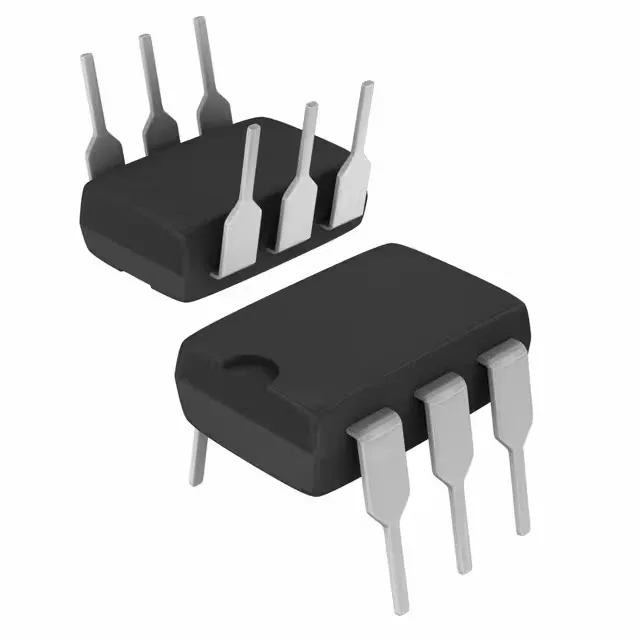
Housed in a standard 6-DIP through-hole package (0.300-inch, 7.62 mm pitch), the TCDT1102 fits existing DIP sockets or solders directly into a PCB. The through-hole format is preferred in designs where vibration resistance or manual rework is a consideration. Operating temperature spans -55 °C to 110 °C, covering industrial and some automotive under-hood environments. The wide range means the optoisolator maintains its isolation and CTR over the full temperature band without derating.
Switching speed and output drive
Typical rise and fall times are 7 µs and 6.7 µs respectively, with turn-on and turn-off times of 11 µs and 7 µs. These speeds suit low-frequency signal isolation — think 50/60 Hz line monitoring, relay drivers, or status feedback at a few kilohertz — but not high-speed data links. The output transistor can sink up to 50 mA continuous with a maximum Vce saturation of 300 mV at that current. The 32 V output breakdown gives headroom for 24 V logic rails or 12 V industrial buses.