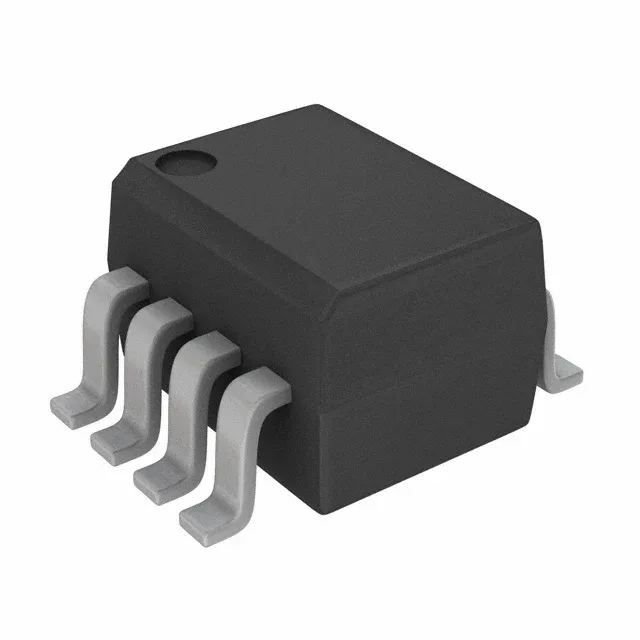
Isolation and CTR — the real margin for a 10-year design
The VOD213T is a dual-channel transistor-output optocoupler from Vishay, packing two isolated channels into a standard 8-SOIC package. Its 4000 Vrms isolation rating covers reinforced insulation for mains-referenced circuits — think isolated feedback loops, PLC digital inputs, or motor-drive status signals where the working voltage stays under 250 Vrms and the transient peak doesn't exceed the 4 kV test level. The headline number that matters for long-term reliability is the Current Transfer Ratio: 100% minimum at 10 mA forward current. That means with 10 mA into the LED, the output transistor sinks at least 10 mA. But the LED fades — CTR degrades over time, especially at elevated temperature. Budget that aging: if your load requires 5 mA at end of life, design for at least 10 mA of headroom at beginning of life. The 50 mA per-channel output ceiling gives plenty of room for that margin, but the real constraint is the minimum CTR after 10 years, not the fresh-from-the-reel number.
Switching speed and signal integrity
Rise and fall times are 5 µs and 4 µs typical, with matching turn-on/turn-off times. This puts the VOD213T in the medium-speed optocoupler class — fine for 10 kHz-ish digital signals like PLC input debouncing, fault flags, or slow PWM gate drive, but not for high-speed comms or switching power supply feedback loops that need sub-microsecond response. The 1.2 V typical forward voltage and 30 mA max forward current set the LED drive: a 330-ohm series resistor from a 5 V logic rail gives about 11 mA, right at the test condition for the CTR spec.
Package and board-fit for SOIC-8
The supplier device package is listed as 8-SOIC, so the land pattern follows the standard JEDEC MS-012 variation. Surface-mount assembly with a 260°C peak reflow profile is typical for this package.