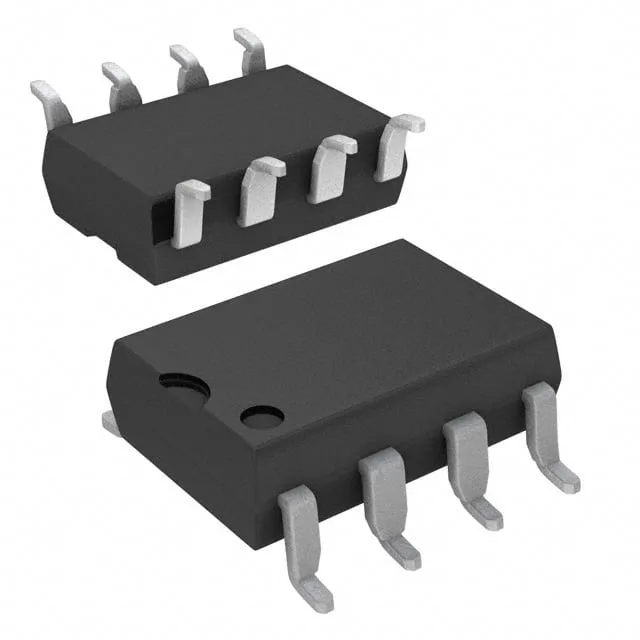
Package and board-fit — 8-SMD gull wing
The SFH6326-X009 comes in an 8-SMD package with gull-wing leads, surface-mount to the board. The supplier device package is designated 8-SMD, and the part ships in tube format. The gull-wing profile gives a visible solder joint for inspection and a bit of compliance if the board and the optocoupler's internal CTE don't perfectly match across temperature. Two channels in one package — that saves board space over two single-channel parts, but the trade-off is that if one channel's LED dies, the whole package comes off. On a repair bench, that scorch mark on the input side tells you which channel actually failed before you reach for the hot-air tool.
Isolation and switching — 5300 Vrms, 200 ns turn-on
5300 Vrms isolation between input and output — this is a reinforced-grade isolation barrier for a dual-channel optocoupler. It handles the transient voltage spikes you see in motor-drive feedback, industrial PLC input modules, or any signal crossing a safety isolation boundary where the working voltage sits below 250 Vrms and the peak transient stays within the 5.3 kV rating. Turn-on time is 200 ns typical, turn-off 500 ns typical. That 2.5:1 asymmetry means the output transistor turns off slower than it turns on — for a 100 kHz PWM signal the duty cycle at the receiver will be stretched by about 300 ns on the falling edge. The output is a standard phototransistor, rated 25 V max and 8 mA per channel, so it drives a logic gate input or a low-current relay coil directly. Minimum current transfer ratio is 19 % at 16 mA forward current. That means with 16 mA into the LED, the output transistor can sink at least 3 mA — enough to pull a TTL or CMOS input low through a 10 kΩ pull-up. The forward voltage is 1.33 V typical, and the LED can take up to 25 mA continuous.
Temperature range and lifecycle
Rated for -55 °C to +100 °C operating ambient — that covers industrial enclosures, outdoor telecom cabinets, and engine-bay-adjacent electronics where the ambient stays below the 100 °C ceiling. The input is DC-coupled, so no AC coupling capacitor on the LED drive; the transistor output is a standard phototransistor, not a darlington, so the switching speed stays in the 200 ns range.