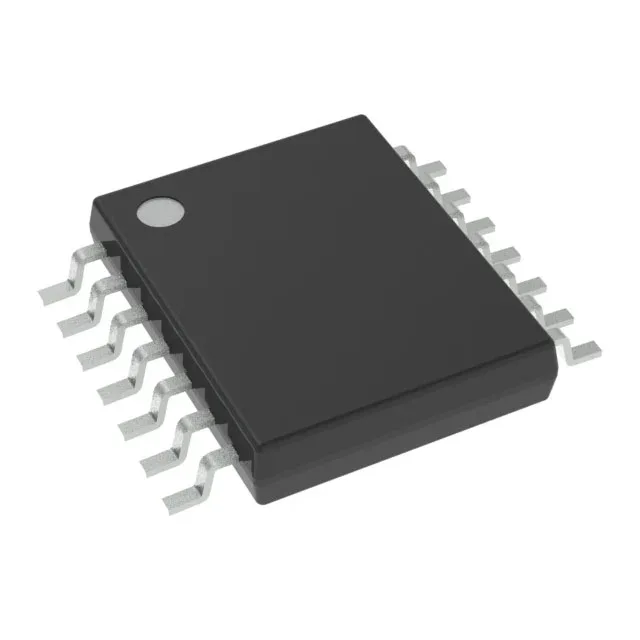
530 MHz bandwidth, 10 Ohm Ron — signal-path fit
The TS12A44515PWR is a quad SPST-NC analog switch from Texas Instruments, built for routing high-frequency analog or digital signals through a single 2.7 V to 12 V supply rail. The 530 MHz -3 dB bandwidth means it passes composite video, 100BASE-TX Ethernet, or RF IF signals up to several hundred megahertz without rolling off the passband — the switch itself is not the bandwidth bottleneck in a typical 50-Ohm terminated line. On-resistance is 10 Ohm max, with channel-to-channel matching held to 2.5 Ohm max. For a 50-Ohm source impedance, the 10-Ohm series resistance adds about 0.8 dB insertion loss — predictable and repeatable across all four channels. The 1:1 multiplexer/demultiplexer circuit means each switch is a single-pole single-throw break-before-make, normally-closed configuration.
Switching speed and charge injection — timing and glitch budget
Turn-on time (Ton) is 75 ns max, turn-off (Toff) is 45 ns max. The asymmetry means the switch opens faster than it closes — useful in sample-and-hold or multiplexed ADC front-ends where the off-isolation must settle before the next channel connects. The 10.5 pC charge injection is the amount of charge dumped onto the signal line during switching; for a 10 pF load capacitance that translates to roughly a 1 V glitch, so a downstream buffer or longer settling time is needed if the load is purely capacitive. Off-leakage current is 1 nA max, and channel capacitance is 8 pF each on source and drain. The 1 nA leakage keeps the off-channel from loading the bus in high-impedance applications like pH probe or photodiode signal routing, where even nanoamps of leakage shift the DC operating point.