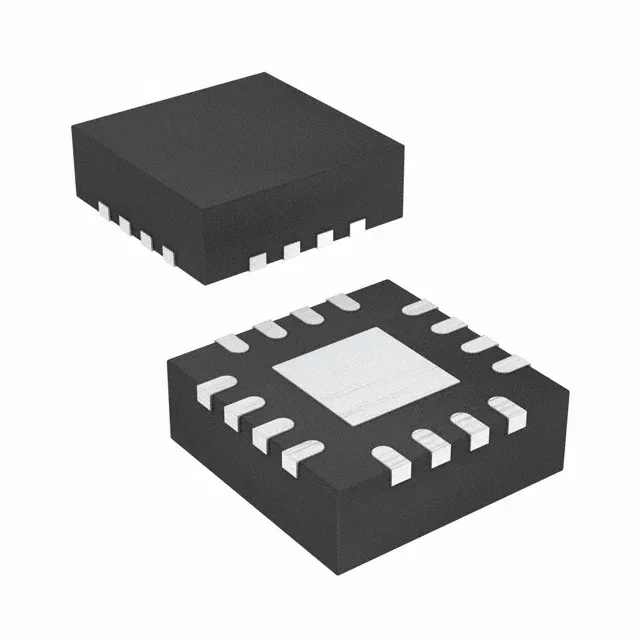
8-bit I²C I/O expander in a 4x4 mm QFN
The PCA9534ARGVR: It provides eight general-purpose push-pull I/O pins that can be individually configured as inputs or outputs, controlled over a two-wire serial bus at clock frequencies up to 400 kHz.
Output drive and interrupt for event-driven sensing
Each I/O pin can source 10 mA or sink 25 mA — enough to drive a logic-level load or an indicator LED directly through a current-limiting resistor. The push-pull output eliminates the need for external pull-ups on output pins, simplifying the BOM. The interrupt output (INT) asserts when an input pin changes state, letting the host controller sleep or poll less frequently. This matters for battery-powered sensor nodes or multi-drop bus applications where the host must not waste cycles polling idle inputs. The POR (Power-On Reset) feature ensures all I/O registers initialize to a known state on power-up — the outputs default to inputs (high-impedance), preventing unintended actuator drive during supply ramp.
Board layout and thermal pad grounding
The 16-VQFN package has a 4x4 mm body with a 0.50 mm pitch — a standard QFN footprint that routes cleanly on a two-layer board if the thermal pad is connected to a ground plane via multiple vias. The supplier device package is 16-VQFN (4x4) — the pad dimensions and via pattern follow TI's recommended land pattern (SLVA004 application note). Without proper thermal vias, the junction-to-board thermal resistance rises, and the -40 to 85 °C ambient rating assumes adequate pad soldering.
Active production and compliance documentation
Texas Instruments lists the PCA9534ARGVR as an active product with ROHS3 compliance. TI provides the datasheet, application notes (e.g., SLVA004 for QFN layout), and RoHS/REACH declarations. The part carries no UL or IEC certification — those are not typical for a standard CMOS I/O expander; compliance is via the datasheet's electrical specifications and the ROHS3 statement.