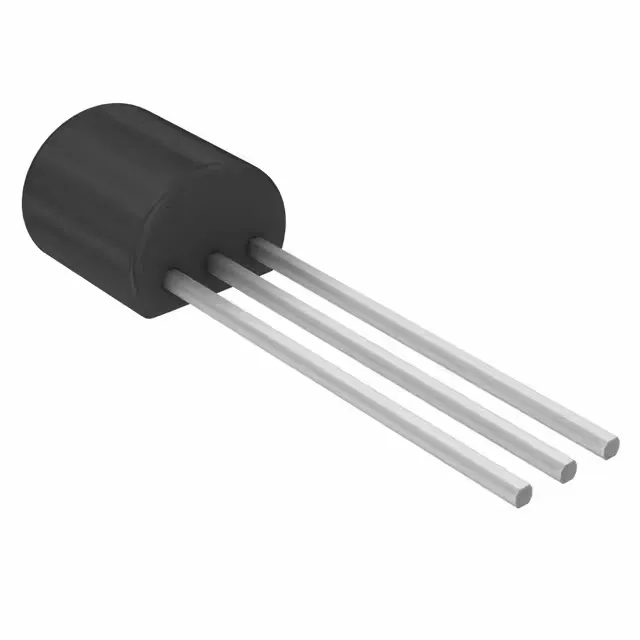
8.192 V shunt reference — the field-swappable choice for precision bias
The Texas Instruments LM4040D82ILP is a fixed 8.192 V shunt voltage reference in a TO-92-3 through-hole package — the same three-lead transistor outline that fits into a socket or solders onto a prototype board without a hot-air station. Rated for 15 mA output current with a 115 µA cathode current, this shunt reference can drive multiple ADC reference inputs or a resistor divider network while keeping its own draw low enough for battery-powered gear.
Noise and output — what the 130 µVrms figure means for your signal chain
For 16-bit systems or low-noise analog front-ends, a 0.1 µF bypass cap across the reference output knocks down the high-frequency tail of that noise floor without affecting the DC accuracy. The 8.192 V fixed output is exactly twice the common 4.096 V reference — handy for bipolar ADC ranges where the full-scale input spans ±4.096 V or ±8.192 V.
Shunt topology — no compensation cap, just a series resistor
As a shunt reference, the LM4040D82ILP behaves like a precision Zener diode — it regulates by shunting current through the cathode, requiring only a single series resistor between the supply rail and the reference pin. No external compensation capacitor is needed, unlike a series reference; the shunt topology is inherently stable and tolerates capacitive loads on the output without oscillation. The trade-off: the total supply current is the load current plus the 115 µA cathode current, so in a 3.3 V system with a 2 kΩ series resistor, the reference draws about 1.7 mA total — fine for most designs but worth noting for ultra-low-power sleep modes.
Active lifecycle and compliance — no rush to buy, no obsolescence worry
ROHS3 compliant (EU 2015/863), so it clears the restricted-substance requirements for European and UK markets without an exemption.