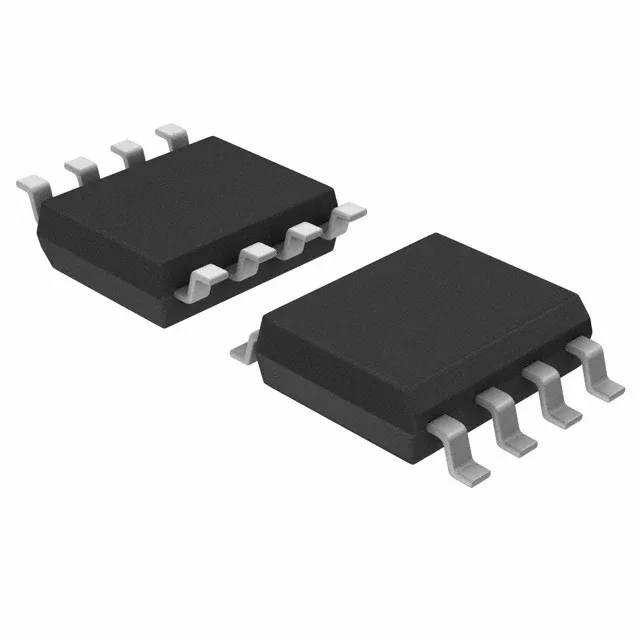
Dual comparator with a wide supply net — 2V to 36V single supply
Its 2V to 36V single-supply range (or ±1V to ±18V split supplies) lets it sit on everything from a 3.3V logic rail to a 24V industrial bus without a secondary regulator. The open-drain output stage — also compatible with CMOS, MOS, and TTL — makes level-shifting to a downstream MCU or FPGA straightforward: just pull up to the logic supply. The 2.5mA max quiescent current per channel is modest for a comparator running off a 24V rail; you won't waste the power budget on the threshold detector.
The open-drain output (listed as CMOS, MOS, Open-Drain, TTL) means the LM2903PSR can drive loads referenced to a different supply than its own Vcc. Common use: pull up to 5V or 3.3V and feed a GPIO directly. The 20mA typical output current handles an LED indicator or a small relay coil with a series resistor. That's a typical industrial-grade comparator figure — fine for overvoltage/undervoltage detection, window comparators, and zero-crossing detectors where a few millivolts of trip-point uncertainty doesn't break the system. If you need sub-millivolt precision, you step up to an automotive-grade variant like the LM2903BQDDFRQ1 with 2.5mV max offset. Maximum input bias current is 0.25µA at 5V. In a high-impedance divider network — say, a 1MΩ resistor string for a battery monitor — that bias current introduces a 250mV error. Keep the divider impedance below 100kΩ to keep the error under 25mV.
No last-time-buy notice, no end-of-life announcement. The 8-SOIC (0.209", 5.30mm width) footprint is a standard, widely second-sourced package — you can dual-source with any LM2903 in the same SOIC-8 body from TI or a licensed alternate.