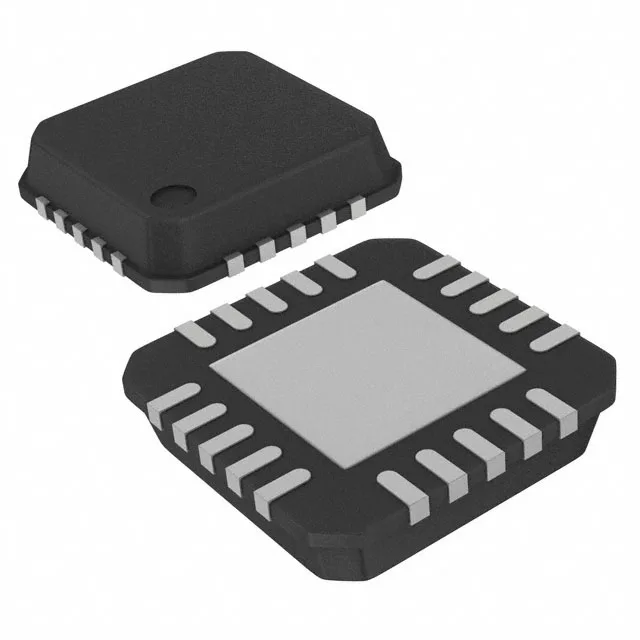
There is no official TI successor listed for this exact variant; if you need a drop-in replacement, the CC1101 family shares the same base number and footprint, but verify the specific order code for lifecycle status.
Frequency bands and link budget
This transceiver covers three sub-1 GHz bands: 300–348 MHz, 387–464 MHz, and 779–928 MHz. That spans the 315/433 MHz ISM bands used globally, the 868 MHz band in Europe, and the 915 MHz band in the Americas. The -116 dBm sensitivity figure is the receiver's noise floor at the supported data rates — it sets the maximum range you can expect in a given environment. At 600 kbps max data rate, this is a moderate-throughput link suited for periodic sensor readings, remote control, or command/acknowledgment protocols rather than continuous audio or video streaming.
Power and supply considerations
Receive current is 14.3 mA to 17.1 mA; transmit current ranges from 12.3 mA to 34.2 mA depending on output power setting (up to 12 dBm).
Modulation and interface flexibility
Modulation options include 2FSK, 4FSK, ASK, GFSK, MSK, and OOK — enough to match most sub-1 GHz protocol stacks (IEEE 802.15.4g, proprietary, or simple on-off keying). The serial interface is SPI only, so the host MCU needs a free SPI port and a GPIO for the chip-select line.