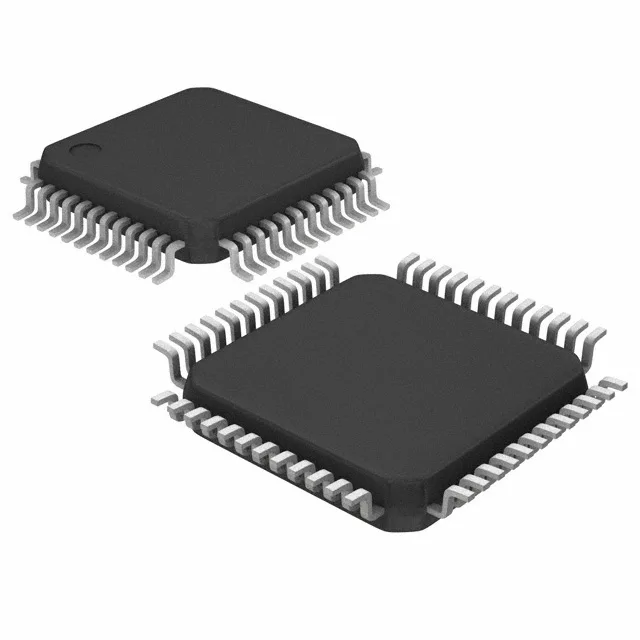
STMicroelectronics STM32F100CBT6B — Microcontrollers & Processors (MCU / MPU / DSP)

ST STM32F100CBT6B ARM Cortex-M3 MCU, 24 MHz, 128 KB Flash

MPNSTM32F100CBT6B
Active

STMicroelectronics STM32F100CBT6B, ARM Cortex-M3 32-bit MCU, 24 MHz, 128 KB Flash, 8 KB RAM, 48-LQFP, -40 to 85°C, 2 V to 3.6 V supply.

$5.7400Ref. price · indicative, final on quote
Packaging48-LQFP
RoHSROHS3 Compliant
SeriesSTM32F1
Independent supplier — new & surplus stockAuthenticity-screened · ESD-safe packingListing updated Aug 2026

Specifications

STM32F100CBT6B specifications
ParameterValue
SeriesSTM32F1
MountingSurface Mount
Oscillator typeInternal
Program memory typeFLASH
Voltage - supply (Vcc (Vdd))2V ~ 3.6V
Operating temperature-40°C ~ 85°C (TA)
Speed24MHz
PackageTray
RAM size8K x 8
Core size32-Bit Single-Core
PeripheralsDMA, PDR, POR, PVD, PWM, Temp Sensor, WDT
ConnectivityI²C, IrDA, LINbus, SPI, UART/USART
Number of i (O)37
Core processorARM® Cortex®-M3
Case48-LQFP
Data convertersA/D 10x12b; D/A 2x12b
Program memory size128KB (128K x 8)

Product details

Value-line Cortex-M3 for cost-sensitive control

The STM32F100CBT6B: This part targets cost-sensitive embedded control applications — motor drives, sensor interfaces, and human-machine interfaces — where the 24 MHz core and integrated peripherals (DMA, PWM, 10-channel 12-bit ADC, dual 12-bit DAC) cover the control loop without the overhead of a higher-performance sibling.

At 24 MHz, the Cortex-M3 executes most single-cycle instructions, giving roughly 24 MIPS. That is enough for a 10 kHz current-control loop with headroom for communications overhead.

Memory sizing: 128 KB Flash, 8 KB RAM

128 KB of Flash is sized for moderate firmware — a bootloader, a real-time kernel, and application code for a motor drive or a simple HMI. The 8 KB SRAM is tight for data buffers.

On-chip peripherals include DMA, a power-on reset (POR), a programmable voltage detector (PVD), a temperature sensor, and a watchdog timer. The 37 general-purpose I/Os are multiplexed with these peripherals, so check the alternate-function mapping in the datasheet when planning your pin allocation.

Package and mounting: 48-LQFP

Frequently asked questions

What is the difference between STM32F100CBT6B and STM32F103C8T6?

The STM32F103C8T6 runs at 72 MHz (vs 24 MHz) and has 20 KB SRAM (vs 8 KB), but draws more current. Both are 48-pin LQFP and share the same pinout, so a hardware swap is possible — but the firmware must be recompiled for the different clock tree and peripheral register map. The STM32F100 is the value-line part; the STM32F103 is the performance-line part.