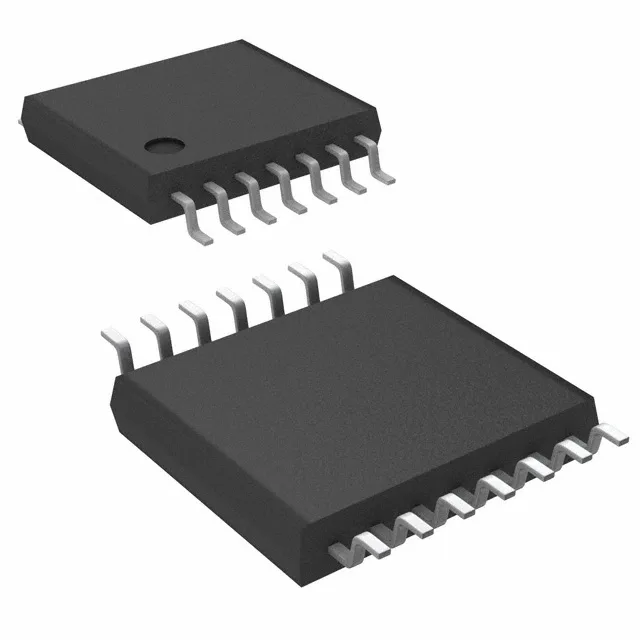
The STMicroelectronics LM224APT is a general-purpose quad operational amplifier in a 14-TSSOP package. It packs four independent op-amp circuits into a compact surface-mount footprint, making it a workhorse for multi-channel signal conditioning, active filtering, and sensor interface stages on space-constrained PCBs. With a supply span from 3 V to 30 V, it runs comfortably on single 5 V or 12 V rails as well as split supplies like ±15 V. The 1.3 MHz gain-bandwidth product and 0.4 V/µs slew rate cover slow-to-moderate-speed loops — think 10 kHz to 100 kHz filter poles, DC error amplifiers in power supplies, or buffering slow ADC inputs. It is not a high-speed video or RF amplifier; the bandwidth is sized for control and measurement paths.
The 3 V minimum supply lets this part operate in 3.3 V systems without a separate rail, though the input common-mode range and output swing near the rails should be checked against the signal headroom. At the top end, 30 V maximum covers 24 V industrial buses with margin. Total package dissipation at 40 mA on all four channels simultaneously needs a thermal check — the 14-TSSOP has no exposed pad, so derate if all outputs are loaded continuously at high ambient. Quiescent supply current is 1.5 mA typical for all four amplifiers combined, which keeps the power budget lean in multi-channel designs.
Input offset and bias — what they mean for precision
The 2 mV typical input offset voltage is adequate for general-purpose sensing where the signal is tens of millivolts or more. For microvolt-level strain gauge or thermocouple amplification, a precision op-amp with lower Vos would be a better fit. Input bias current of 20 nA typical is bipolar-transistor territory — acceptable with source impedances up to a few tens of kΩ. Higher source resistances will produce an offset voltage error from the bias current flowing through the source impedance.
Because it is an active, current-generation part, the supply channel is stable through franchised distribution.