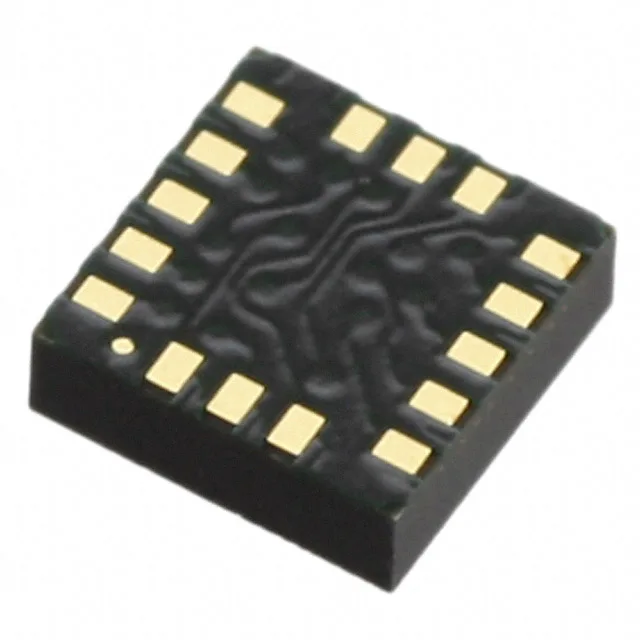
The ±100g measurement range places this part firmly in the high-g accelerometer category. It is not a low-g tilt or orientation sensor (typically ±2g to ±16g). Instead, it is intended for applications that must capture large transient accelerations: automotive crash detection, industrial machine condition monitoring, hard-drive free-fall sensing, or sports equipment impact logging. The sensitivity is 1 LSB/g, which gives a resolution of roughly 1g per count — adequate for detecting events above 10g but not for fine vibration analysis below 1g.
Digital interface and bandwidth flexibility
The H3LIS100DLTR communicates over I²C or SPI, both common serial buses on microcontrollers and SoCs. This digital output saves board space and BOM cost compared to an analog accelerometer plus ADC. The programmable bandwidth range of 25 Hz to 200 Hz lets the designer tailor the low-pass filter cutoff to the mechanical bandwidth of the event being measured — a 25 Hz setting for slow vibration monitoring, or 200 Hz for capturing faster shock impulses. The sleep mode feature reduces power consumption when the device is idle, which is useful for battery-operated edge nodes that wake periodically to log events.