What the 88 dB PSRR means for your analog rail
The LD1086D2MTR is an adjustable positive LDO regulator from STMicroelectronics, rated for 1.5 A continuous output. Its headline spec is 88 dB of power-supply rejection at 120 Hz — that is the ripple attenuation from a full-wave rectified mains supply. For an audio codec or precision ADC front-end running off a 12 V bus that has 100 mV of 120 Hz ripple, the LDO knocks that down to roughly 4 µV at the output, keeping the noise floor out of the signal band.
Dropout and headroom — the 1.5 V floor
Maximum dropout is 1.5 V at the full 1.5 A load. If the output is set to 5 V, the input must stay above 6.5 V across line and load transients to keep the pass transistor in regulation. The 30 V absolute maximum input gives plenty of headroom for 12 V or 24 V industrial rails, but the dropout figure sets the practical lower bound on the input rail. Quiescent current is 10 mA — not a micropower part. For always-on rails in battery gear this matters; for a 24 V industrial sensor supply drawing 500 mA the 10 mA Iq is a 2 % overhead, acceptable in most panel designs.
Temperature range and protection — industrial duty
Built-in over-current and over-temperature protection fold back the output before the die reaches destructive temperatures.
D2PAK package — thermal management on the PCB
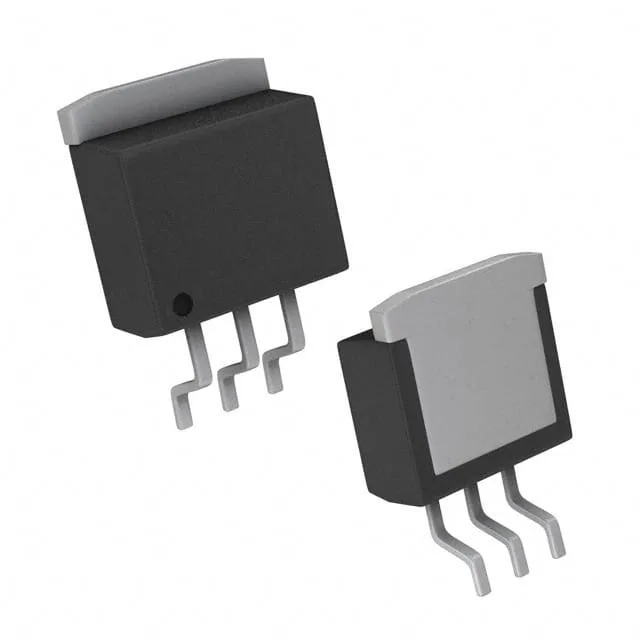
The D2PAK (TO-263-4, 3 leads plus tab) surface-mount package relies on the exposed copper tab soldered to a PCB pad for heat sinking. At 1.5 A with 3 V input-to-output differential, the LDO dissipates 4.5 W — the PCB copper area and airflow determine whether the junction stays under 125°C. The tab is the output pin electrically, so the PCB trace carries both the load current and the heat.
Adjustable output — setting the voltage
Output is adjustable from a 1.25 V reference up to 28.5 V using two external resistors in the classic LDO divider configuration.