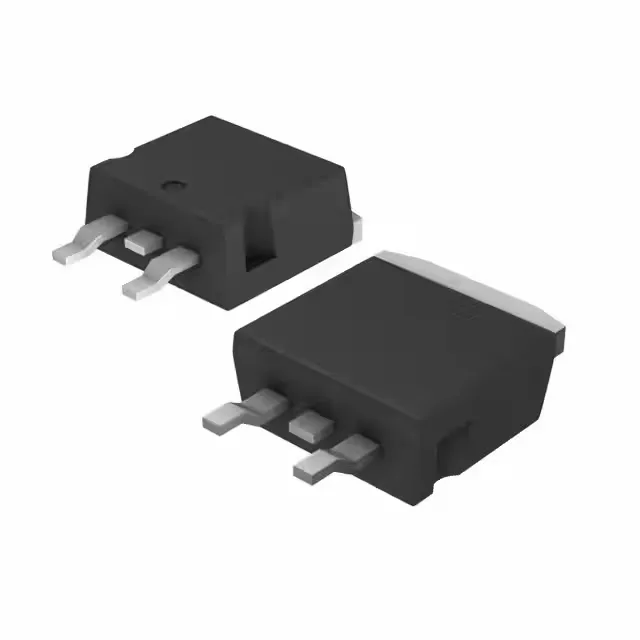
Negative rail workhorse: -5 V fixed, 1.5 A in D2PAK
The STMicroelectronics L7905ACD2T-TR is a fixed-output negative linear regulator delivering -5 V at up to 1.5 A in a surface-mount D2PAK (TO-263) package. It is part of the L79xx family of three-terminal negative regulators, designed for applications requiring a clean, regulated negative rail from an unregulated negative input up to -35 V. Typical uses include bipolar analog supplies for op-amps, ADCs, and audio circuits, as well as industrial control boards where a -5 V rail is needed for legacy logic or sensor bias.
Dropout and headroom planning
The maximum dropout voltage is specified as 1.4 V at 1 A output (typical). This means the input voltage must be at least -6.4 V (absolute) to maintain regulation at full load. A common practice is to allow 2 V to 3 V of headroom above the dropout for line transient margin and to keep the pass transistor out of saturation. For a -12 V input rail, the margin is generous; for a -6.5 V rail, it is tight and requires checking against the input tolerance.
PSRR and ripple rejection
The PSRR is 60 dB at 120 Hz, which is typical for a 1.5 A negative regulator. This provides about 1000:1 attenuation of full-wave-rectified ripple from a 50/60 Hz mains supply. For a 1 V p-p ripple on the input, the output ripple is around 1 mV p-p. This is adequate for most analog circuits, but if the load draws near the full 1.5 A, the PSRR degrades at higher frequencies — plan local bypassing at the load for high-speed rails.
Thermal management in D2PAK
At 1.5 A with a typical dropout of 1.4 V, the regulator dissipates about 2.1 W. Without a thermal plane, the junction temperature will exceed the 125°C maximum at full load. For continuous operation at 1.5 A, a 1 oz copper pad of at least 2 square inches on the top layer, with thermal vias to inner and bottom layers, is recommended.
Protection and reliability
Built-in over-temperature and short-circuit protection are included, which reduce the need for external protection circuitry. The quiescent current is 3 mA typical, which is modest for a 1.5 A regulator.