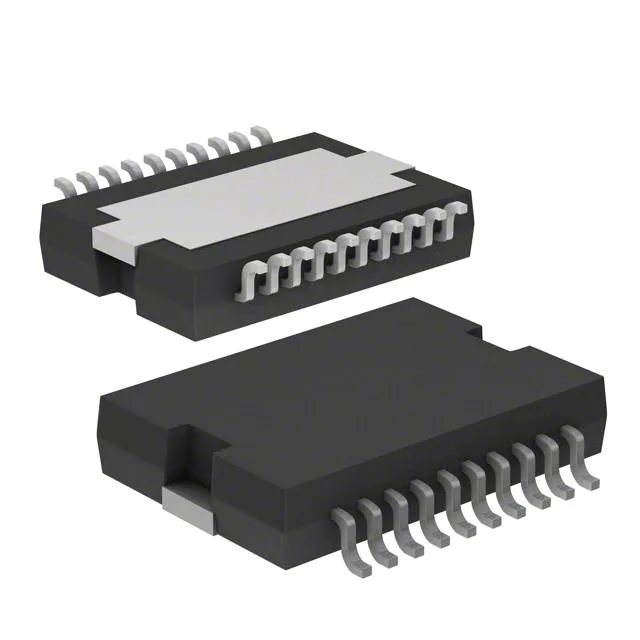
STMicroelectronics L298P013TR — Analog & Data Acquisition
Technical Documents PDF / CAD
RoHS Compliant · Lead-Free EIA-481 Standard
STMicroelectronics / Analog & Data Acquisition

STMicroelectronics L298P013TR Half-Bridge Driver, 2A Peak

MPN L298P013TR
End of Life Spot Stock · 24-48h Dispatch 100% Original Sealed

STMicroelectronics L298P013TR, half-bridge driver IC, 4 half bridges, 2A peak output, 4.8V–46V load voltage, 4.5V–7V logic supply, PowerSO-20 package, -25°C to 130°C junction temperature.

In Stock: 805 pcs
MOQ: 1 pcs
Logistics: DHL / FedEx DAP (Global Express · 3-7d) Russia & CIS DDP (Door-to-Door Cleared)
Dispatch: Shenzhen / HK
Unit Price (USD)
$11.07 / pc
Direct Purchase Ready
Volume Pricing Breaks Confirmed upon quotation
1+ pcs
$11.07
10+ pcs
$9.57
30+ pcs
$8.65
100+ pcs
$7.54
Working on a production BOM or have a target unit price? Submit Target Price
Buy Now

$11.07 / ea

805 in stock — maximum per order · 3–4 days lead time

$9.57 / ea from 10 pcs

Upload Full BOM List
[SPEC] Essential Parameters Snapshot Full Specifications (13)
Package / Case 20-SOIC (0.433", 11.00mm Width) Exposed Pad
Supply Voltage 4.5V ~ 7V
ALT
Facing long factory lead times or allocation on L298P013TR? Verified pin-compatible alternatives available with active Shenzhen stock and 100% solder-ready footprint match.

Full Technical Specifications

13 Parameters
L298P013TR specifications
Parameter / AttributeSpecification / Value
Load typeInductive
MountingSurface Mount
Voltage - load4.8V ~ 46V
Supply voltage4.5V ~ 7V
Current - peak output2A
InterfaceLogic
Operating temperature-25°C ~ 130°C (TJ)
PackageTape & Reel (TR); Cut Tape (CT)
TechnologyBipolar
ApplicationsDC Motors, Relays, Solenoids, Stepper Motors
Case20-SOIC (0.433\", 11.00mm Width) Exposed Pad
Fault protectionCurrent Limiting, Over Temperature
Output configurationHalf Bridge (4)
100% Footprint Match · Solder-Ready (No PCB Redesign Needed)

Need Stock or a Drop-in Second-Source for L298P013TR?

Package: MultiWatt-15 / module · Pin-compatible replacements with immediate Shenzhen spot stock

Footprint Match 97%
Supply Chain & Allocation Reality:

The L298N is the motor driver of the red breakout module that has fronted a million robots and CNC builds - a dual full-bridge in MultiWatt-15 with 2A-per-channel capability and a price that made it the default. Its reputation runs ahead of its datasheet in one direction only: the Darlington output stage drops 1.4V to 3V depending on current, which on a 6V robot supply is a third of the battery spent as heat. The bare chip also needs external flyback diodes that the modules provide and small repairs often omit. Two honest conversations belong on this page: L293D is the smaller cousin with built-in diodes, and the modern MOSFET drivers (TB6612FNG and the DRV row) are the reason new designs stopped choosing this part.

Verified Pin-Compatible Replacements (2 verified alternatives)

L293D STMicroelectronics / TI DIP-16
Functional Equivalent
Availability & Target Pricing:

The Smaller Cousin with Built-in Diodes

Shenzhen Spot Stock (24-48h Dispatch)

Electrical & Core Specs:

Quadruple half-bridge (two full bridges) rated about 600mA per channel continuous with 1.2A non-repetitive peaks against the L298N 2A class - and the D suffix folds the flyback diodes inside.

4.5V to 36V; same Darlington-era voltage drop, so poor on 6V motor rails.

Compatibility & Drop-In Notes: The substitution direction on current: L298N parts replace L293D positions freely; the reverse starves anything drawing near an amp. The diode difference runs the other way - the L298N bare chip brings none.
Package & Solder Footprint: DIP-16 against MultiWatt-15: different sockets entirely, module boards vary.
Shenzhen Warehouse Stock & MOQ: Universal stock; the beginner-class staple.
TB6612FNG Toshiba SSOP-24 / module
Functional Equivalent
Availability & Target Pricing:

The MOSFET Generation - The Honest Upgrade

Shenzhen Spot Stock (24-48h Dispatch)

Electrical & Core Specs:

MOSFET output stage dropping about 0.5V against the L298Ns 1.4-3V: 1.2A continuous / 3.2A peak per channel, natively 3.3V-logic compatible, roughly 90 percent efficient.

Motor rail ceiling about 13.5V - the trade against the L298Ns 35-46V class. Battery robots win; industrial rails stay with the old part.

Compatibility & Drop-In Notes: The honest design sentence: below about 13V, no new board should choose the Darlington part - the MOSFET driver runs cooler, longer on the same battery and speaks 3.3V logic without level shifting. The L298N remains for higher voltages and legacy repair.
Package & Solder Footprint: SSOP-24 chip or its own breakout module - not a socket substitute for the MultiWatt part.
Shenzhen Warehouse Stock & MOQ: Volume stock with module boards; the current default for new battery-powered builds.
Buyer & Quality Checklist for Sourcing Alternatives
  • The Darlington drop is the design number: about 1.4V minimum, up to 3V+ per bridge at current. On a 6V supply that is a third of the energy as heat - check the numbers against the battery before blaming the motors.
  • The bare L298N needs external flyback diodes; the common red modules include them. A repair that transplanted just the chip onto a module board and skipped the diode check reintroduces the failure that killed the first one.
  • Sense resistors (the two low-side pins) are how current feedback works on this part: designs that used them lose that behavior if the substitute module grounds those pins directly.
  • Thermal path is half the 2A rating: MultiWatt-15 on a heatsink with compound; module boards with tiny fins are honest for about an amp of continuous duty.
  • Enable pins are also the PWM inputs on the modules: two jumpers removed equals two PWM channels - repairs that restore the jumpers by habit take the speed control away.
  • For new designs under about 13V, compare a MOSFET driver (TB6612FNG class) before defaulting to the Darlington part: the efficiency difference is not subtle, it is the battery life.
Frequently Asked Technical Questions

Q: What is the difference between L298N and L293D?

A: Current and diodes: L298N passes about 2A per channel and needs external flyback diodes, L293D is about 600mA per channel with the diodes built in. Same Darlington-era voltage drop; different sockets. The L298N replaces the L293D upward, not the reverse.

Q: Why does my L298N get so hot?

A: By design: the Darlington output drops 1.4V to over 3V at current, and that difference is heat. Check the heatsink and compound, and for battery designs under 13V consider a MOSFET driver - the efficiency gap is the whole story.

Q: Is TB6612FNG a replacement for L298N?

A: As a design, yes - the modern MOSFET alternative for anything under about 13.5V, far cooler and 3.3V-friendly. As a board, no: different package and pinout (own module). Above 13.5V the L298N class remains the available choice.

Technical Details & Description

The STMicroelectronics L298P013TR is a bipolar-technology half-bridge driver IC built for driving inductive loads — DC motors, stepper motors, relays, and solenoids. It integrates four half bridges, each rated for a peak output current of 2A, with a load supply range from 4.8V up to 46V. The logic supply runs on 4.5V to 7V, making it compatible with 5V microcontroller I/O directly. Fault protection includes current limiting and over-temperature shutdown, which saves adding external sense resistors or thermal watchdogs in many designs.

The 2A peak per bridge is the headline number, but it is a peak rating, not continuous. For continuous DC motor drive, derate based on the package's thermal impedance and ambient temperature. The exposed pad on the PowerSO-20 helps pull heat into the PCB copper — without a good thermal land and via array, the driver will hit the 130°C junction limit well before 2A sustained. If you are driving a stepper motor, each winding sees one bridge, so a 1A-per-phase stepper is a comfortable fit with margin.

Frequently asked questions

Can L298P013TR drive stepper motors?

Yes, the L298P013TR has four half bridges, which can be configured as two full H-bridges to drive a bipolar stepper motor. The 2A peak per bridge handles common 1A–1.5A per-phase steppers with margin.

Does L298P013TR require an external heat sink?

The PowerSO-20 package includes an exposed pad designed to conduct heat to the PCB. For continuous loads near the 2A peak rating, a thermal via array under the pad and adequate copper area are essential. An external heat sink is not required if the PCB thermal design is adequate, but it may be needed for sustained high-current operation in hot environments.

L298P013TR
Verified Allocation
Quote