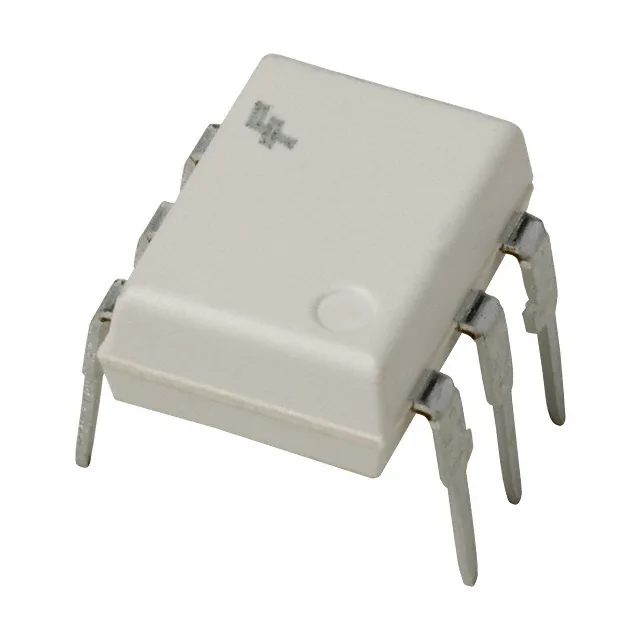
The H11AV1M is a single-channel optocoupler from onsemi with a DC input LED and a phototransistor output that brings out the base pin. The 4170 Vrms isolation rating (cite:) lets it bridge a 240 VAC mains-referenced circuit to a low-voltage control side — think PLC digital inputs, motor drive feedback, or AC-line zero-cross detection. The base-access transistor output gives the designer the option to add a base-emitter resistor for noise immunity or to tailor the switching threshold.
Current transfer ratio is specified at 100% minimum and 300% maximum at a forward current of 10 mA (cite:,). That 3:1 spread means you don't need to hand-select parts for a given load resistor — the same H11AV1M will drive a TTL or CMOS logic input across the full CTR window. The 15 µs typical turn-on and turn-off time (cite:) limits the part to switching frequencies below about 30 kHz; for faster signals like 100 kHz serial data, look at the H11A1TVM peer which specifies 2 µs typical switching (cite:).
Active production and compliance status
onsemi lists the H11AV1M as Active (cite:) with ROHS3 compliance (cite:). The 6-DIP through-hole package (cite:) is a standard 0.300-inch body width, which mates with common DIP sockets or wave-solder processes. For a surface-mount alternative on the same die, the H11AV1SM uses the same electrical specs in an SMD package (cite:).
Temperature grade and industrial deployment
The 70 V maximum output voltage (cite:) and 400 mV Vce saturation (cite:) are typical for a general-purpose phototransistor opto; the saturation voltage matters when the output must swing close to ground to guarantee a logic-low threshold.