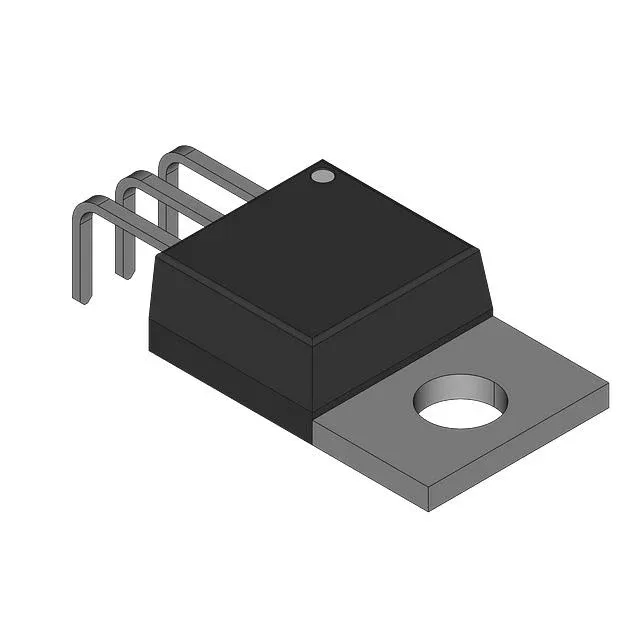
TO-220AB package and rework fit
The BTA310-600C,127: Through-hole TO-220-3 with the tab as the collector terminal — the metal tab is the main heat path and the electrical connection to the die backside. The three leads are on 2.54 mm pitch, standard for a TO-220 footprint. The bulk packaging means the parts ship in tubes or trays, not tape-and-reel — fine for bench builds and rework, but for automated pick-and-place you would need a tube feeder or a manual load.
10 A RMS on-state and 600 V off-state — what it means for the load
Rated 10 A RMS continuous on-state current — this is the thermal limit through the TO-220AB package with the tab properly heatsunk. For a resistive load like a heater or incandescent lamp, the RMS current is the design ceiling; for an inductive load like a motor or solenoid, derate by 20–30% for the reactive component. 600 V off-state voltage covers 240 VAC mains with margin — the peak of a 240 VAC sine is 340 V, so the 600 V rating gives a 260 V headroom for line transients. For 277 VAC lighting circuits the peak is 392 V, still within the rating. Non-repetitive surge current is 85 A at 50 Hz and 93 A at 60 Hz — this is the one-cycle peak the die can survive for a fuse-clearing event or a capacitor inrush. The 60 Hz figure is higher because the shorter half-cycle deposits less energy.
3-quadrant triac — snubber consideration
Listed as a standard 3-quadrant triac, meaning it triggers in quadrants I, II, and III but not IV. This is the common type for AC phase control with a triac driver or optocoupler that provides a positive gate pulse; a 4-quadrant part would be needed for negative-gate-trigger circuits or certain zero-crossing schemes. Gate trigger current is 35 mA max, gate trigger voltage 1.5 V max — a standard logic-level triac driver like the MOC3063 can drive this directly through a current-limiting resistor. The 35 mA holding current means the triac drops out of conduction if the load current falls below that threshold near the zero crossing.
Active lifecycle and sourcing
Sourced through authorized distribution; availability and current pricing confirmed at RFQ against the BOM quantity.