Active DDR3 SDRAM for production BOMs
The Micron MT41J128M16JT-093:K is a 2 Gbit DDR3 SDRAM organized as 128M x 16, running at a 1066 MHz clock rate with a 20 ns access time. The x16 data bus width is the primary fit criterion — it mates with memory controllers expecting a 16-bit wide chip, common in DIMM modules and embedded systems that need a single-chip data path rather than two x8 parts.
Speed bin and timing closure
The -093:K speed grade specifies a 1066 MHz clock (data rate 2133 MT/s) with a 20 ns access time. This is the faster bin compared to the -125:K sibling which runs at 800 MHz. When selecting this part, the memory controller's timing parameters — particularly tRCD, tRP, and tCL at the target frequency — must be verified against the datasheet's AC timing tables to ensure the controller can close timing at 1066 MHz without violating setup/hold margins. The 20 ns access time reflects the time from the column address strobe to the first data output. For a controller running at 1066 MHz (cycle time ~0.94 ns), this access time spans about 21 clock cycles — well within the DDR3 read latency budget, but the exact CAS latency programmed in the controller's mode register must match the part's speed bin rating.
Package and board integration
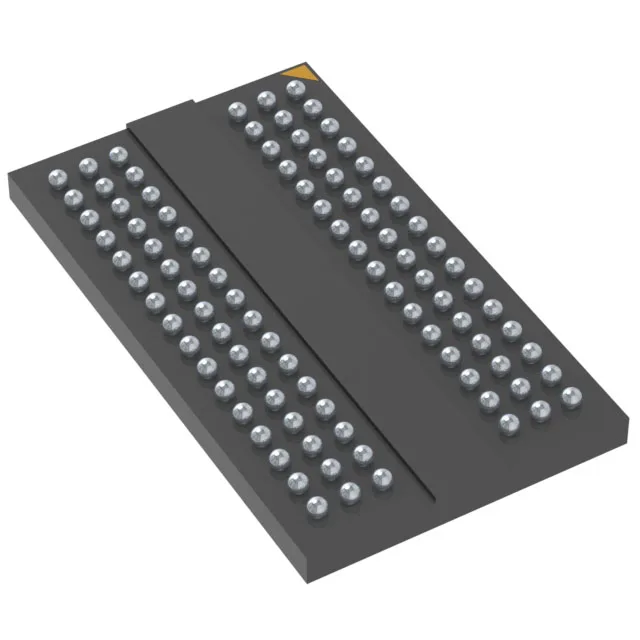
The 96-ball FBGA package is the standard DDR3 footprint — 0.8 mm ball pitch, 14 x 22 ball array. The surface-mount package requires a 4-layer or more PCB to fan out the signals, with careful impedance matching for the DDR3 data, address, and control lines (typically 40-60 ohm single-ended, 80-120 ohm differential for the clock pair). The bulk packaging means the parts ship in tubes or trays, not tape-and-reel — confirm with your assembly house whether they can handle bulk trays on the pick-and-place feeder. Decoupling capacitance placement is critical: one 0.1 µF ceramic per VDD/VDDQ ball pair, placed within 1 mm of the ball, plus a 10 µF bulk cap per supply rail on the board. The 1.425 V supply rail has a tolerance of ±0.075 V per the JEDEC DDR3 standard, so the regulator output must stay within 1.35 V to 1.50 V across load transients.
Sourcing posture for this DDR3 line
The bulk packaging may affect lead time compared to tape-and-reel versions — confirm the packaging preference with your procurement team before placing the order.