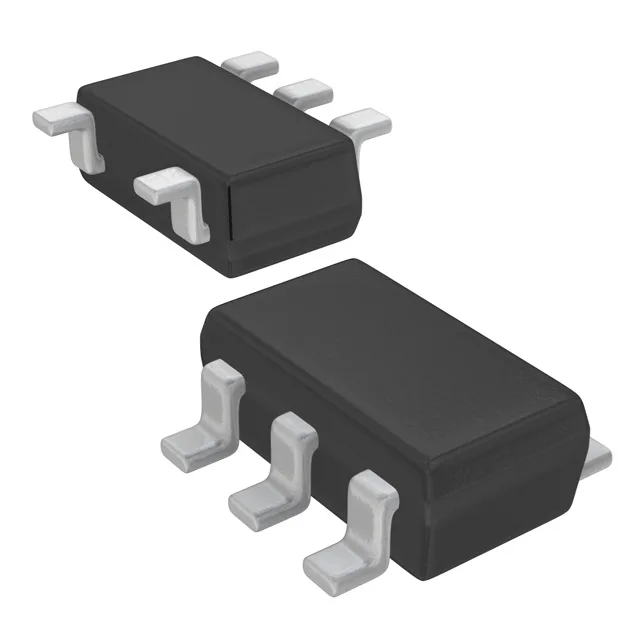
10mV/°C analog output — what the scaling means for your ADC
The MCP9700AT-E/LT outputs an analog voltage that scales linearly at 10mV/°C, so at 25°C the output sits at 0.75V (0.5V offset + 0.25V from the 25°C rise). A 10-bit ADC with a 2.5V reference reads this as about 307 counts — giving roughly 0.25°C per LSB, which is finer than the sensor's own ±2°C accuracy band. This is a local, analog-output sensor — no digital interface, no configuration registers. The output is ratiometric to the supply; if the ADC reference tracks Vdd, the measurement stays accurate across the 2.3V to 5.5V supply range without a separate voltage reference.
Temperature range and accuracy — the real measurement uncertainty
The accuracy spec is ±2°C from 0°C to 70°C, widening to -2°C/+4°C outside that band — at 125°C the reading could be 4°C high, which matters if you're using the sensor for thermal shutdown near a junction limit. Test condition is noted at 0°C to 70°C for the tightest accuracy band; the wider tolerance at the extremes is a known trade-off in this class of silicon-bandgap sensor. If your application spends most of its life at -20°C or 105°C, budget the wider error into your alarm thresholds.
SC-70-5 footprint — board integration notes
The SC-70-5 (SOT-353) package measures 2.0mm × 1.25mm with a 0.65mm pin pitch — small enough to fit on a tight sensor node or a multi-channel temperature monitoring board. The supplier device package is SC-70-5, so the land pattern matches the standard JEDEC MO-203 footprint. No exposed pad — the die is in a standard molded plastic package. A 0.1µF decoupling cap close to the supply pin is sufficient; the sensor draws under 100µA typical, so trace inductance is not a concern.
Active lifecycle — no end-of-life risk for new designs
The base product number is MCP9700, and the AT-E/LT suffix denotes the tape-and-reel packaging and the extended temperature range variant.