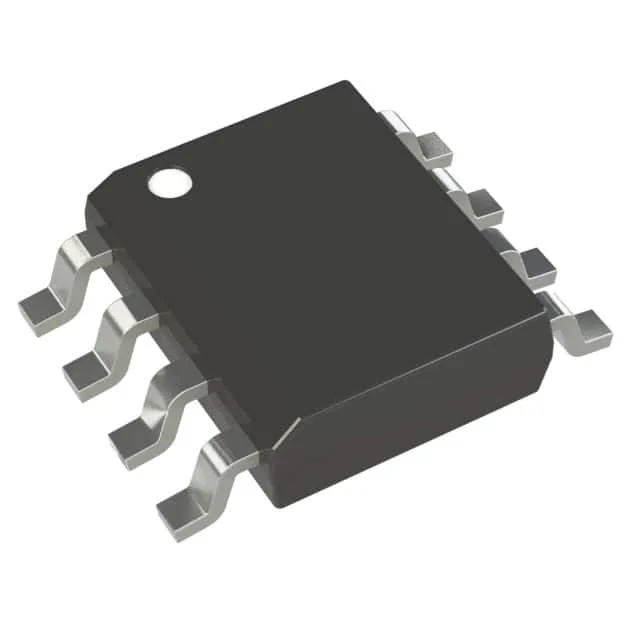
What this 4Kbit EEPROM does on your board
The 93LC66CT-E/SN is a 4Kbit serial EEPROM from Microchip's 93LC66C family, organized as 512 x 8-bit or 256 x 16-bit, selected by the ORG pin. It communicates over a 3 MHz Microwire bus — a simple three-wire serial interface (SI, SO, SK) that needs no address lines, saving GPIO on the host controller. Supply voltage spans 2.5V to 5.5V, covering both 3.3V and 5V logic domains without a level shifter. This is a non-volatile memory — data retention is specified by Microchip for 200 years typical, and the part supports at least 1 million erase/write cycles per the family datasheet. It is used for storing calibration constants, configuration parameters, serial numbers, or small lookup tables in sensor modules, industrial controllers, and automotive ECUs.
Temperature grade and package — where it fits physically
That range suits outdoor telecom cabinets, engine-bay electronics, and factory-floor sensors where the commercial 85°C ceiling would be marginal. Housed in an 8-pin SOIC (0.154-inch body width, 3.90 mm), surface-mount. Cut Tape (CT) is also available for prototype or low-volume builds.
ROHS3 compliant per. No official second-source or direct replacement is published — the part is sole-sourced to Microchip. If you need to qualify an alternative, the 93LC46CT-I/SN (1Kbit, 85°C) is a pin-compatible drop-in with half the density — useful only if your firmware fits in 1Kbit.
Memory organization — 512x8 or 256x16, your call
The ORG pin selects between 512 x 8-bit (ORG tied low) and 256 x 16-bit (ORG tied high). In 8-bit mode, each address holds one byte; in 16-bit mode, two bytes per address. The Microwire protocol handles the addressing automatically — the host sends the opcode and address bits, and the part responds with data on the SO line. At 3 MHz clock, a sequential read of the full 4Kbit array takes about 1.7 ms. The 6 ms write cycle is per word or page — page size is 16 bytes in 8-bit mode or 8 words in 16-bit mode. If you are writing calibration data at power-up, budget 6 ms per page plus the internal write time.