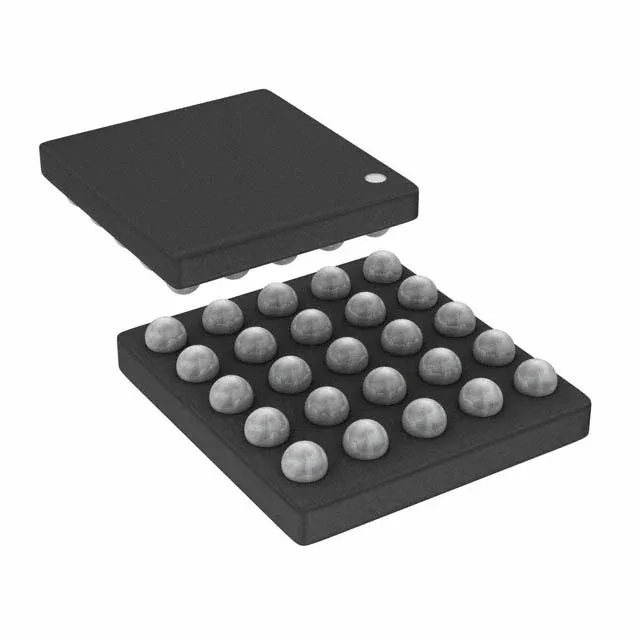
1280 LEs in a 25-ball WLCSP — board-area constrained glue logic
The LCMXO2-1200ZE-1UWG25ITR1K packs 1280 LUT-based logic cells and 18 user I/O into a 25-ball WLCSP measuring roughly 2.5 × 2.5 mm — roughly the footprint of a 0402 resistor array. That density targets applications where a QFP or BGA simply will not fit: wearable sensor hubs, compact camera modules, or handheld test probes that need a few dozen gates of custom sequencing or level translation without a separate CPLD. 64 Kbit of embedded block RAM (distributed as EBR) is enough for small FIFOs, look-up tables, or coefficient storage — typical for a glue-logic FPGA that bridges a sensor interface to a host processor.
18 I/O — what you can and cannot do with them
Eighteen user I/O on a 25-WLCSP is the limiting factor for this part. The ball map dedicates several pads to power and ground, leaving 18 for signals. That suits a simple SPI or I2C bridge, a few GPIO expanders, or a state machine that monitors three or four sensors and drives a single PWM output. It will not handle a 16-bit parallel bus or a full memory interface. Compare to the TQFP-100 sibling LCMXO2-1200ZE-1TG100I, which offers 79 I/O in a 14×14 mm package — the WLCSP trades I/O count for a 90% smaller footprint. If your board has the real estate, the TQFP variant gives you four times the I/O for the same logic fabric.
RoHS3 compliant, so it passes the EU recast directive without exemption declarations.