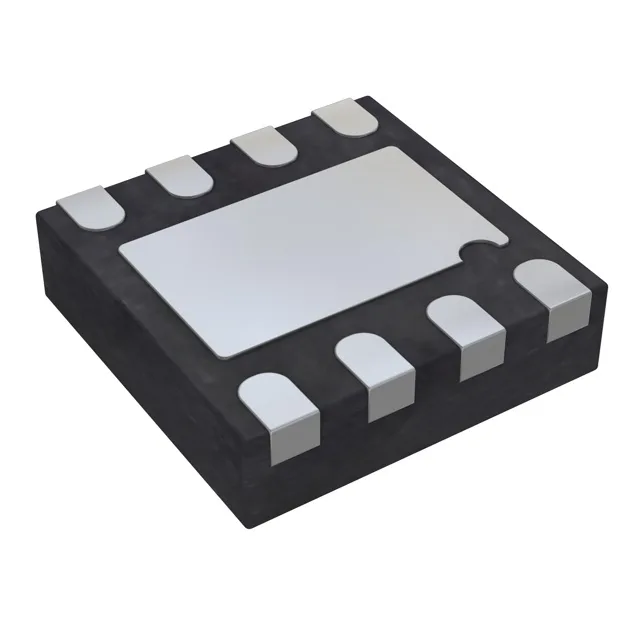
Analog Devices ADPD2140WBCPZN-R7 — Sensors & Transducers

ADPD2140WBCPZN-R7 – Analog Devices NIR Filtered Photodiode

MPNADPD2140WBCPZN-R7
Active

Analog Devices ADPD2140WBCPZN-R7, discrete filtered photodiode, 0.363 mm² active area, 0.4 A/W responsivity at 880 nm, 0.786 pA switching current, -40°C to 105°C, surface-mount.

$4.28Ref. price · indicative, final on quote
Independent supplier — new & surplus stockAuthenticity-screened · ESD-safe packingListing updated Aug 2026

Specifications

ADPD2140WBCPZN-R7 specifications
ParameterValue
MountingSurface Mount
Operating temperature high-40°C to 105°C
Display_color_depthInfrared (NIR)
Active area0.363mm²
Package_typeTape & Reel (TR); Cut Tape (CT)
StatusActive
Response time258.0
Supply voltage8.0
Responsivity @0.4 A/W @ 880nm, 0.025 A/W @ 660nm
Switching current0.786pA

Product details

Filtered NIR photodiode for pulse oximetry and proximity

The ADPD2140WBCPZN-R7 is a discrete filtered photodiode from Analog Devices with a 0.363 mm² active area. Its responsivity peaks at 0.4 A/W at 880 nm in the near-infrared band, while the 660 nm red response is only 0.025 A/W — the on-chip filter rejects visible light so the signal chain sees only the NIR LED return. The 0.786 pA switching current is the dark leakage floor; any transimpedance amplifier selected for the front end must have an input bias current well below this to avoid swamping the photocurrent.

Response time and operating temperature envelope

The 258 ms response time is the time constant of the photodiode junction capacitance and the external load resistor — it sets the upper bound on the modulation frequency of the LED drive. For pulse oximetry where the LED is chopped at a few kHz, this is not the limiting factor; the downstream ADC sampling rate will be.

Frequently asked questions

Can ADPD2140WBCPZN-R7 be used for ambient light sensing?

No — this is a filtered photodiode with peak responsivity at 880 nm and strong rejection at 660 nm. It is designed to detect NIR LED returns in pulse oximetry or proximity applications, not broadband ambient light. For ambient light sensing you would want a photodiode with a wider spectral window or a dedicated ambient-light sensor IC.