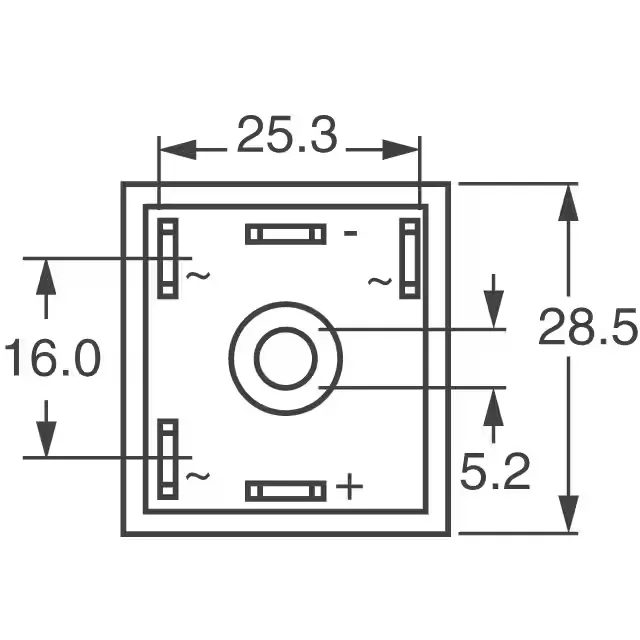
Three-phase bridge in a D-63 power tab
The VS-36MT10 is a Vishay three-phase bridge rectifier in the D-63 package, rated for 100 V peak reverse voltage and 35 A average rectified output. That 35 A is the average over a full cycle — the actual peak current the diodes handle per phase is higher, so the thermal design needs to account for the conduction angle and the heatsink's ability to pull heat out of the D-63 tab. Mounting is via QC (quick-connect) terminals, which means the rectifier is intended for a chassis or panel mount with push-on spade connectors — not soldered into a PCB. The D-63 package is a 5-square power-tab format that bolts or clips to a heatsink; the junction-to-case thermal path is short, so the limiting factor is usually the heatsink interface, not the die itself.
The QC terminal format and D-63 footprint are standard across the 36MT series, so a mating connector and heatsink clip are off-the-shelf items.
Temperature range and reverse leakage
The 10 µA reverse leakage at 100 V is specified at 25°C; leakage roughly doubles every 10°C rise, so at 125°C junction the leakage current can approach 1 mA. That matters for standby power budgets and for balancing resistors in series-stacked rectifiers. The 100 V peak reverse rating is the repetitive blocking voltage. For a three-phase bridge on a 50/60 Hz line, the peak line-to-line voltage after rectification is about 1.35× the RMS line voltage — so a 100 V bridge comfortably handles a 70 V RMS three-phase input with margin for transients. The 35 A average rating assumes a resistive or inductive load; capacitive-input filters increase the RMS current through the diodes and may require derating.