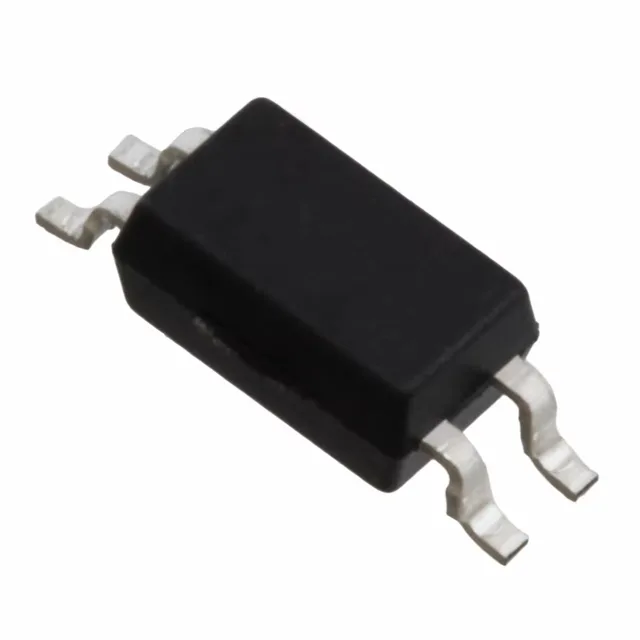
3750 Vrms isolation in a 4-SSOP — what it buys you
The VOS617A-4T is a single-channel transistor-output optocoupler from Vishay, packing 3750 Vrms of galvanic isolation into a compact 4-SSOP package (4-SOIC footprint, 4.40 mm width). That isolation rating is the spec that decides whether your low-voltage control side stays alive when the power rail takes a hit — it's sized for basic reinforced insulation in mains-isolated SMPS feedback loops, PLC digital inputs, and motor-drive interface circuits where you need a clean break between the high-side and the logic ground. The output is a standard phototransistor with a Vce(max) of 80 V and a saturation voltage of 400 mV at rated current — enough to drive a 5 V or 3.3 V logic input directly through a pull-up resistor. The 50 mA per-channel output current handles most gate-drive or signal-isolation jobs without a buffer stage.
CTR binning — 160% to 320% at 5 mA forward current
The current transfer ratio is the key parametric for a transistor-output optocoupler: it tells you how much collector current you get for a given LED forward current. The VOS617A-4T is binned with a CTR range of 160% to 320%, measured at If = 5 mA. That's a relatively tight bin — it means you can design the pull-up resistor and the logic threshold without a huge guard band for CTR variation across temperature and ageing. The typical forward voltage is 1.18 V at that same 5 mA drive, so the LED side is compatible with 3.3 V logic outputs through a series resistor.
Active production, ROHS3, wide temperature range
For a repair bench, that means this part is a drop-in replacement for any 4-pin SOIC optocoupler in that temperature class.
Switching speed — 3 µs rise/fall, 6 µs turn-on
That's in the range of a standard phototransistor optocoupler — fast enough for 10–100 kHz switching in a power-supply feedback loop or a 19.2 kbps RS-232 isolator, but not for high-speed digital isolation (that would call for a digital isolator or a logic-output optocoupler).