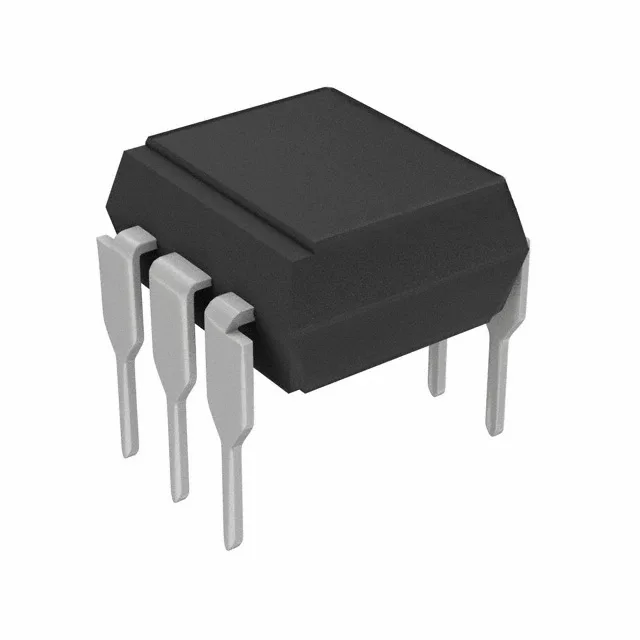
The BRT13H is a single-channel triac-output photocoupler in a through-hole 6-DIP package, designed for isolating low-voltage control logic from AC mains loads. Its 800 V off-state voltage rating suits it for direct switching of 240 VAC or 277 VAC lines with adequate margin for mains transients. The 300 mA RMS on-state current covers solenoid valves, small contactors, solid-state relay drivers, and resistive heater loads within that current budget.
No zero-crossing — random-phase switching for phase-control applications
This part has no zero-crossing detection circuit, so the triac fires immediately when the LED current exceeds the 2 mA maximum trigger threshold. That makes it suitable for phase-angle dimming, soft-start, and other applications where the load must be switched at an arbitrary point in the AC cycle — not just at the voltage zero crossing. The 10 kV/µs minimum static dV/dt rating provides good immunity against false triggering from line transients or commutating dV/dt from inductive loads.
Isolation and safety agency coverage
Rated for 5300 Vrms isolation between input and output, the BRT13H carries CQC and UL approvals, covering safety certification requirements for equipment sold into China and North America. The -40°C to 100°C operating temperature range covers most industrial-control and motor-drive environments, though the 100°C upper limit means the part should not be placed directly against a heatsink or in a sealed enclosure without thermal analysis.
LED drive and trigger characteristics
The LED forward voltage is 1.1 V typical, with a maximum continuous forward current of 20 mA. The 500 µA holding current means the triac will commutate off cleanly when the load current drops below that threshold near the AC zero crossing — important for ensuring the triac turns off when the control signal is removed.