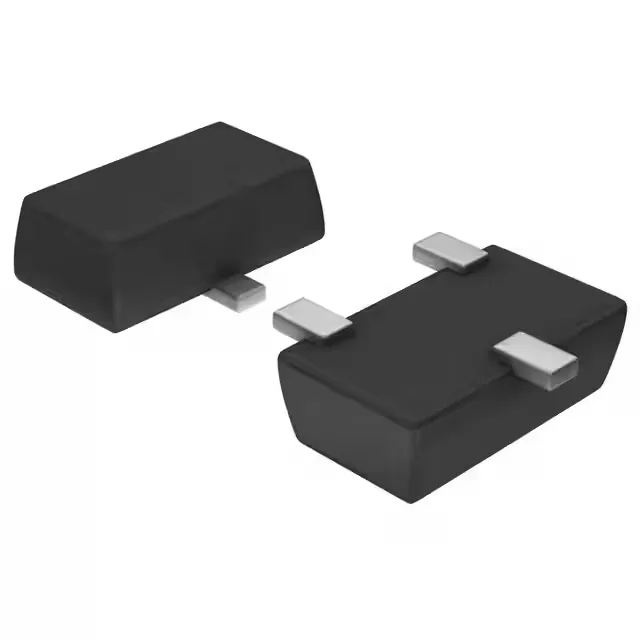
Active production — BOM-fit for a magnetic switch
The Toshiba TCS40DLR,LF is an active-production omnipolar magnetic switch in the TCS series, packaged in SOT23F for surface-mount assembly. It detects both north and south pole fields, making it a single-device solution for proximity or position sensing where the magnet orientation isn't fixed. Rated for a 2.3 V supply with a switching current of 1.6 mA and a maximum output current of 5 mA, the part fits low-power battery-operated designs where the sensor must stay awake without draining the rail.
±4.4 mT trip — what the threshold means for the magnet gap
The sensing distance is specified as ±4.4 mT trip and ±0.9 mT release at 25°C. The 3.5 mT hysteresis between trip and release prevents output chatter when the magnet sits near the threshold — a common issue in vibrating assemblies where the field strength oscillates. Because the release point is only 0.9 mT, the switch stays latched until the magnet moves well away from the sensor face. This wide hysteresis band suits applications like door-closure detection where a brief field disturbance shouldn't toggle the output.
Open-drain output — pull-up resistor required
The output signal is open drain, meaning the device pulls the line low when a magnetic field is detected but cannot drive it high. An external pull-up resistor to the logic supply is mandatory — without it the output floats and the downstream microcontroller input sees an undefined state. The 5 mA maximum output current limits the pull-up value; a 1 kΩ resistor to 3.3 V would draw 3.3 mA, within the rating, but a 470 Ω resistor would exceed it. The pull-up should be sized so the current through the output FET stays below 5 mA at the logic-high voltage.
Industrial temperature range — -40 to 85°C
The magnetic thresholds shift with temperature — expect the trip point to drift by roughly ±0.1 mT per 10°C from the 25°C value, though the datasheet's typical curve is the reference for bench validation.
Sourcing posture — active, quoted to order
The SOT23F footprint is shared across the TCS40 family, so the board layout accommodates either the open-drain TCS40DLR,LF or the push-pull TCS40DPR,LF without a PCB change — only the output pull-up network differs.