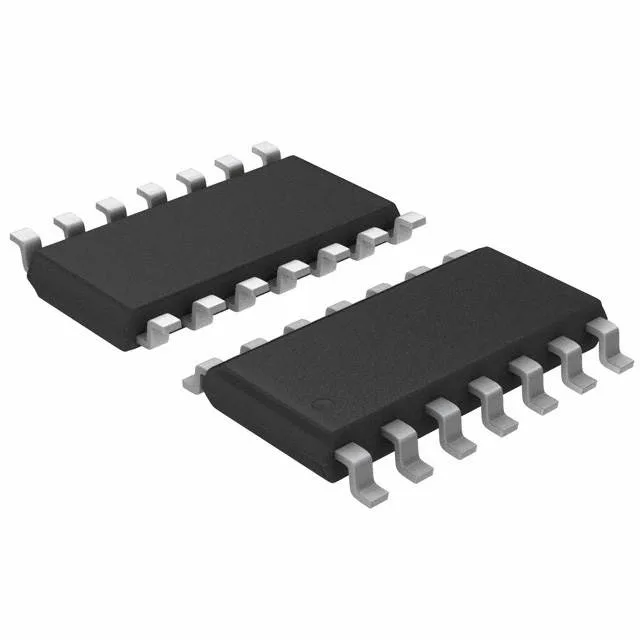
Quad SPST analog switch — 80Ohm R_on, 200MHz bandwidth
The Toshiba 74HC4066D is a quad SPST analog switch in a 14-SOIC package. Each of the four switches is a 1:1 multiplexer/demultiplexer circuit, meaning each channel is a simple on/off pass gate. The on-state resistance is 80Ohm max, with channel-to-channel matching at 5Ohm typ — so for a differential signal pair, the gain error between channels stays under 6% at matched load. The -3dB bandwidth is 200MHz, and the switch time (Ton, Toff) is 12ns max each way. This means the 74HC4066D can pass a 10MHz analog signal with less than 0.5dB attenuation, and the switching edge is fast enough for multiplexing low-speed digital buses up to about 40MHz.
Supply rails and signal integrity
At 5V supply, the typical on-resistance drops to about 40-50Ohm, but the 80Ohm max covers the full temperature and process corner. Crosstalk is -60dB at 1MHz — for a 1Vpp signal on an adjacent channel, the coupled noise on a switched-off channel is about 1mVpp. This is good enough for audio routing or low-frequency analog muxing, but for high-precision 16-bit ADC front-ends above 100kHz, the -60dB floor may limit the SNR budget. Leakage current is 100nA max per channel in the off state, and channel capacitance is 3pF. The RC time constant from the 80Ohm R_on and 3pF C_off gives a 240ps settling time — negligible for most analog signals under 10MHz.
Temperature grade and board fit
The 14-SOIC (3.90mm width) footprint is a standard JEDEC outline — it drops into any SOIC-14 land pattern without board spin. The surface-mount package is available in Tape & Reel for automated pick-and-place, or Cut Tape for prototype runs.
RoHS3 compliant — the part contains no restricted substances above the threshold limits, which clears it for EU, UKCA, and most Asian markets without exemption paperwork.