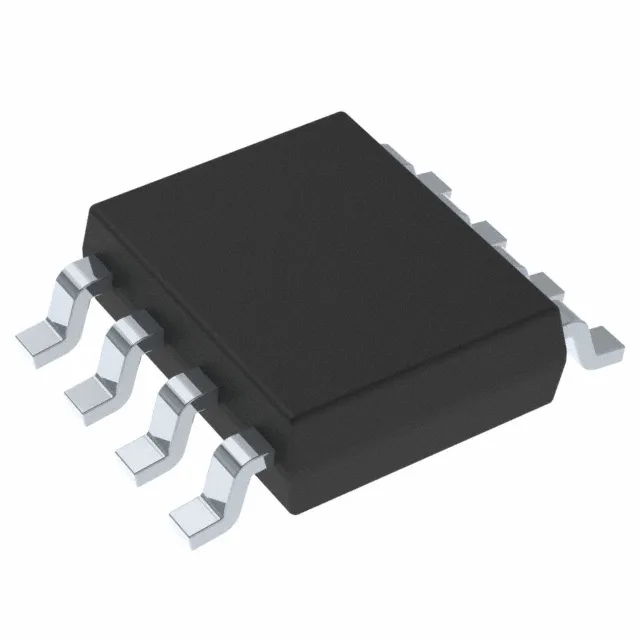
Active production — current-feedback topology with 7300 V/µs slew rate
The THS3091DDAG3: Current-feedback architecture means the -3 dB bandwidth stays relatively flat across gain settings — unlike voltage-feedback amps where gain-bandwidth product forces a trade-off. This part maintains 235 MHz bandwidth at gains up to about +10, making it suitable for wideband pulse amplifiers, video distribution, and ADC drivers where the signal swing is large and fast.
7300 V/µs slew rate — large-signal pulse fidelity
The 7300 V/µs slew rate defines how fast the output can swing under large-signal conditions. For a 10 V peak-to-peak output step, the rise time is roughly 1.4 ns — fast enough to reproduce 100 MHz square waves with minimal slew-induced distortion. This matters in pulse generators, laser diode drivers, and pin electronics where the edge rate, not the small-signal bandwidth, limits the throughput. The 280 mA output current per channel lets the amplifier drive 50-ohm loads directly to ±7 V swing without an external buffer. In a video line driver or arbitrary waveform generator output stage, this eliminates a post-amplifier stage and its associated propagation delay.
8-SO PowerPad — thermal management in a compact footprint
The 8-PowerSOIC package with exposed PowerPad requires a thermal land on the PCB with multiple vias to the ground plane. The pad must be soldered to the board — it is not a no-connect tab. The datasheet recommends a 4-layer stack-up with the pad connected to the inner ground layer through at least 9 thermal vias to keep the junction temperature below 125°C at full output current into a 50-ohm load. Surface-mount assembly on standard FR-4; the 0.154-inch body width (3.90 mm) fits the SOIC-8 footprint with the extended pad. The tube packaging means the part ships in anti-static tubes — order in multiples of the tube quantity for automated placement.
Supply range and quiescent draw — 10 V to 30 V span
Operates from a single supply of 10 V to 30 V or split supplies of ±5 V to ±15 V. The 30 V maximum limits the rail-to-rail headroom — with ±15 V rails the output can swing to within about 2 V of each rail at 280 mA load. The 9.5 mA supply current per amplifier is moderate for this speed class; a dual-channel design would draw 19 mA total from the rails. The 4 µA input bias current flows into the inverting input — typical for current-feedback amps. This is not negligible when the source impedance exceeds a few kilo-ohms; the bias current multiplied by the feedback resistor value adds a DC offset. For precision DC-coupled paths, a servo loop or AC coupling may be needed. The 900 µV input offset voltage is the untrimmed value; external nulling is not provided on this pinout.
Industrial temperature range — -40°C to 85°C ambient
Rated for -40°C to 85°C operating ambient, covering most industrial, test-and-measurement, and telecom environments. Not qualified to AEC-Q100 — this is not an automotive-grade part. The ROHS3 compliance means no RoHS exemptions; the part is fully lead-free and suitable for EU markets.