What this dual flip-flop does on your board
The DM7474N is a dual D-type flip-flop from the 7400 series, packing two independent positive-edge-triggered flip-flops with complementary outputs and separate Set (Preset) and Reset pins per element. Each flip-flop samples the D input on the rising clock edge and holds that state until the next clock — the Set and Reset override the clock, letting you force the output high or low without waiting for a clock edge. Rated for a 15 MHz maximum clock frequency with a 40 ns propagation delay at 5 V into a 15 pF load — fast enough for TTL-level glue logic in 8-bit bus interfaces, state machines, and debounce circuits.
Supply rails, drive strength, and quiescent draw
Quiescent current is 30 mA typical, meaning the flip-flop pair draws about 15 mA per element when idle — budget this into the 5 V rail's total current, especially on a multi-chip board. Output high current is 400 µA, output low sinks 16 mA — the high-side drive is weak, so driving a LED or relay coil directly from the Q output needs a pull-up or a buffer; the low-side sink is strong enough for TTL fan-out to ten standard loads.
Through-hole package and rework bench reality
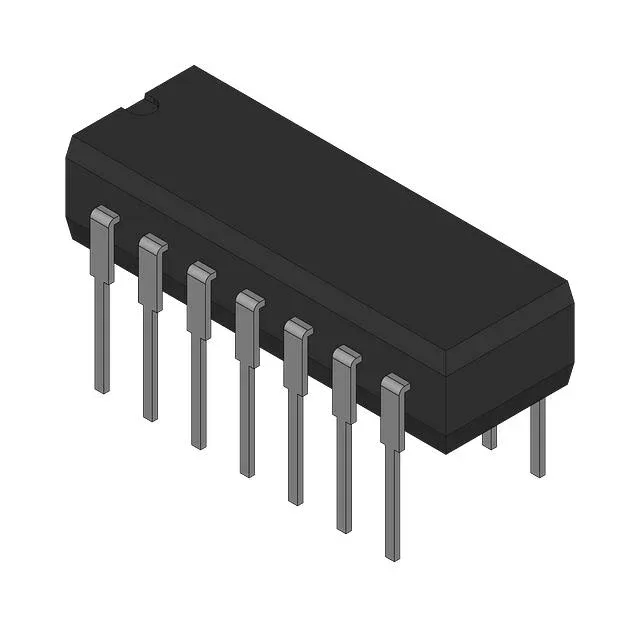
Housed in a 14-pin DIP (0.300-inch, 7.62 mm pitch) with through-hole mounting — the supplier device package is 14-PDIP. This is a rework-friendly package: the 0.100-inch pin spacing gives plenty of room for a desoldering iron or solder wick, and the plastic body survives a 260 °C wave-solder profile without moisture sensitivity issues — no bake-out required before hand rework. Pin 1 is clearly marked by a notch at the top end of the DIP body — orientation is unambiguous under a magnifier, so a technician can drop it into a socket or solder it in without cross-wiring.
Temperature grade and where it runs
Not specified for -40 °C or 85 °C — if the board lives in an unheated enclosure or under a vehicle dash, step up to a 74LS or 74HC variant with the wider temperature range. RoHS non-compliant per the manufacturer — the lead finish on the DIP pins is likely tin-lead solder, which is fine for legacy builds and rework but may trigger a waiver if the final product must meet RoHS 3/2015/863.
How it compares to the 74LS175 quad flip-flop
The DM7474N gives you two flip-flops per DIP with separate Set/Reset per element; the 74LS175 packs four flip-flops with a common Master Reset and no individual Set — the choice depends on whether you need per-bit override or density. They are not pin-compatible: the DM7474N is 14-DIP through-hole, the 74LS175NS is 16-pin SOIC surface-mount — swapping one for the other requires a board layout change.