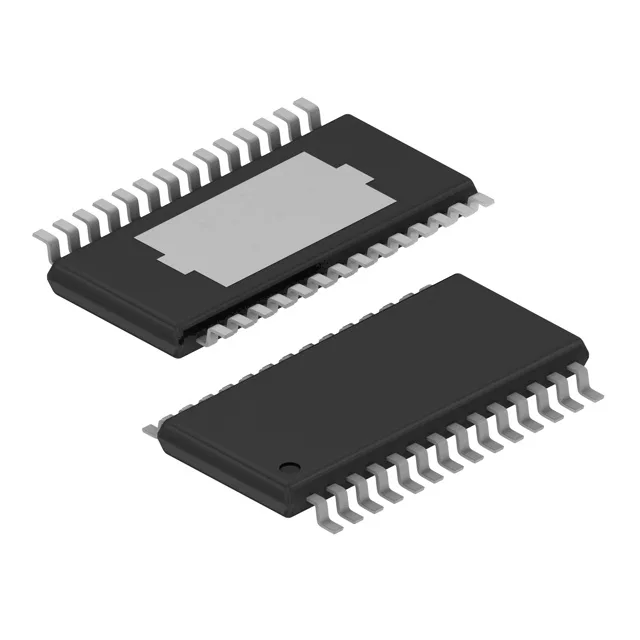
Dual synchronous buck controller for high-density POL rails
The LM5642MH/NOPB: Each output phase delivers a transistor-driver signal to external MOSFETs, making this a controller rather than a full integrated regulator — the power stage is off-chip, so the thermal dissipation stays on the FETs, not in this 28-PowerTSSOP package. Switching at 200 kHz with synchronous rectification built into the control loop, it hits a max duty cycle of 98.9% — that means it can regulate down to a very low output voltage from a high input rail without dropping out.
What the 200 kHz switching and 98.9% duty cycle mean on the bench
200 kHz is on the slow side for modern POL converters — you're not shrinking the magnetics into a tiny footprint. But the trade-off is lower switching losses in the external FETs and better noise immunity in a noisy industrial backplane. The clock sync input (says Clock Sync Yes) lets you lock the switching edge to an external clock, which keeps the ripple harmonics out of sensitive analog bands when you're stacking multiple rails. The 98.9% duty cycle matters when you're running, say, a 3.3 V output from a 3.6 V input — the controller stays in regulation right up to the dropout edge. Below that, the output follows the input minus the FET and inductor drops. The control features include current limit, enable, and soft start, so you can sequence the two outputs and limit inrush on a high-capacitance load.
Package reality for the layout and rework bench
The tube packaging means you're getting the parts in a stick, not a reel; plan for manual placement or tube-fed pick-and-place if your line is set up for tape. The 4.40 mm width and 0.173-inch body length are standard for this family. The exposed pad is on the bottom, so the reflow profile needs a good paste coverage under the die attach area — a stencil aperture that covers 50-70% of the pad is common. No special bake required unless the moisture sensitivity level calls for it (that's on the bag label, not in this listing).