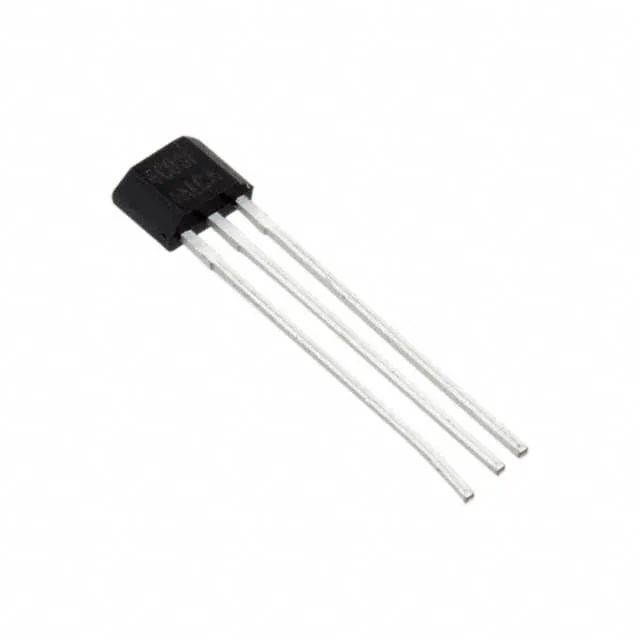
±73 mT single-axis Hall — what it resolves and where it sits
The DRV5053OAQLPGM is a single-axis linear Hall-effect sensor from TI's automotive-qualified DRV5053 family, delivering an analog voltage output proportional to the perpendicular magnetic field. Its ±73 mT sensing range covers most air-gap scenarios in current sensing, position feedback, and proximity detection — enough to resolve a 10 mT magnet moving across a 5 mm gap without saturating the output. Output is a ratiometric analog voltage, meaning the output scales linearly with the supply voltage — useful when sharing a noisy 12 V rail because the ADC reference can track the same supply, cancelling ripple.
20 kHz bandwidth and temperature compensation — application ceiling
A 20 kHz bandwidth lets this sensor track magnetic field changes up to 20,000 cycles per second — fast enough for brushless DC motor commutation at 10,000+ RPM with a 2-pole magnet, or for high-speed linear position encoders. Below that ceiling, the analog output settles with no digital latency. Without it, the Hall element's intrinsic sensitivity drifts ~0.1%/°C; the compensation circuitry holds the gain flat enough that a 12-bit ADC reading stays within 1 LSB of truth from cold start to under-hood soak.
Active production, AEC-Q100, TO-92-3 package
It is part of TI's Automotive, AEC-Q100 series, qualified for stress grades up to 125°C ambient. The TO-92-3 through-hole package is a standard three-lead footprint — same as a small-signal transistor — which means it can be hand-soldered, wave-soldered, or socketed without a reflow profile.
Supply rail flexibility — 2.5 V to 38 V
The 2.5 V to 38 V supply range means this sensor can run directly off an automotive 12 V or 24 V battery bus without a local regulator — the internal bias circuitry rejects common-mode supply ripple. Maximum supply current is 3.6 mA, and the analog output can source up to 2.3 mA into an ADC input or a 10 kΩ load.