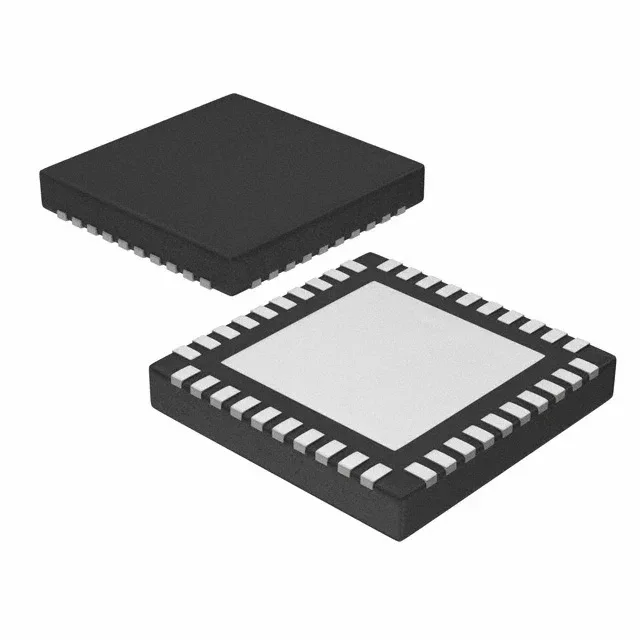
What this BLE SoC brings to the board
It is designed for Bluetooth Low Energy (BLE) and basic-rate/enhanced-data-rate (BR/EDR) applications where a compact, low-power wireless node must also run application code without a separate host MCU. With 21 GPIOs, SPI, USART, and USB serial interfaces, the CC2540TF256RHAT can handle sensor polling, actuator control, and data logging alongside the BLE stack. The 256 kB Flash provides room for the protocol stack plus a custom application, while the 8 kB SRAM limits the data buffer size — fine for periodic sensor reports, tight for over-the-air firmware update staging.
Receiver sensitivity and transmit power — what they mean for link range
The -93 dBm receiver sensitivity at 1 Mbps data rate gives a typical line-of-sight range of about 100 meters in open air with the +4 dBm maximum transmit power. In practice, indoor range drops to 30–50 meters through walls, and the 19.6 mA to 22.1 mA receive current and 21.1 mA to 31.6 mA transmit current (at +4 dBm) set the battery budget for a coin-cell-powered beacon or sensor tag.
Texas Instruments lists the CC2540TF256RHAT as an active product with no announced end-of-life. For BOM planning, the base product number CC2540 covers multiple Flash and package variants, so a second-source alternate within the family exists if supply tightens — but there is no pin-compatible second source from another manufacturer.